
Sports Ministry Tells Athletes to Deliver at Asiad, Says Funding Is No Excuse

Sports Ministry Puts Federations on Notice After Asian Games Setback, Says Funding No Longer an Excuse
The Union Sports Ministry has sent a strong message to national sports federations following India’s underwhelming performance at the Asian Games, making it clear that financial support can no longer be cited as a reason for failing to deliver results. Sports Minister Mansukh Mandaviya has urged federations to focus on measurable improvements, athlete development and accountability.
The message came during a review meeting held on Thursday to assess India’s performance at the Aichi-Nagoya Asian Games and chalk out a roadmap for future international competitions, including the 2028 Los Angeles Olympics.
The meeting was chaired by Mandaviya and attended by Minister of State for Sports Raksha Khadse, Indian Olympic Association (IOA) President P.T. Usha, Sports Secretary Hari Ranjan Rao, Target Olympic Podium Scheme (TOPS) CEO N.S. Johal and representatives of various National Sports Federations (NSFs).
India finished the Asian Games campaign with 85 medals, including 21 gold, considerably below its tally of 106 medals at the previous edition in Hangzhou, China. The country’s performance in traditionally strong disciplines, particularly athletics and badminton, came under scrutiny during the review.
A senior official present at the meeting told PTI that Mandaviya made it clear that the government had provided sufficient resources to support athletes and that federations must now demonstrate results on the field.
“The Minister was very clear that there is no dearth of resources and the NSFs can no longer complain about financial support. The federations have to deliver. They have to not just make presentations but deliver on the ground,” the official said.
Although the federations presented their assessments and recommendations, the meeting primarily focused on evaluating performance and planning for upcoming competitions rather than announcing major decisions.
Athletes’ Injuries and Fitness Under Scrutiny
The condition of key athletes who competed despite injuries also emerged as a concern. During the presentation by Athletics Federation of India (AFI) adviser Adille Sumariwalla, IOA President P.T. Usha reportedly raised questions about the fitness of hurdler Jyothi Yarraji and triple jumper Praveen Chithravel, whose injury concerns became apparent during the Games.
According to the official, Mandaviya intervened and emphasised that the discussion should concentrate on the overall performance of the contingent rather than individual cases.
The fitness of distance runner Avinash Sable also attracted attention. The defending 3,000m steeplechase champion did not start the 5,000m race after finishing fourth in his specialist event. At the Hangzhou Asian Games, Sable had won gold in the steeplechase and silver in the 5,000m.
Athletics was among India’s biggest disappointments in Aichi-Nagoya. The discipline’s gold medal tally dropped from six in Hangzhou to just one, while the overall medal count fell to 24, five fewer than in the previous edition.
Mandaviya Calls for More Young Champions
In a statement released after the meeting, the Sports Ministry said Mandaviya had called on federations to establish a continuous pipeline of young talent capable of competing at the highest international level.
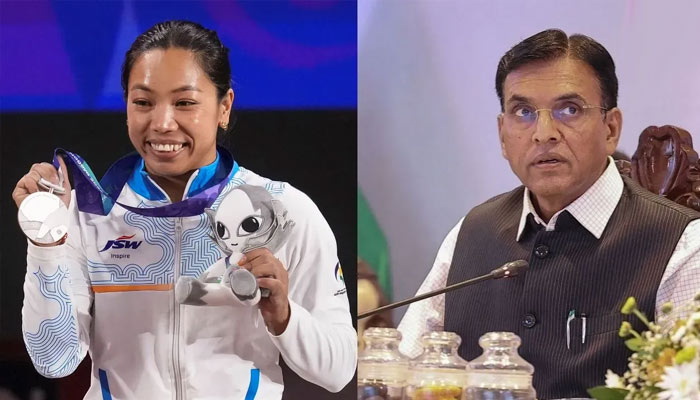
Referring to weightlifter Mirabai Chanu, who won silver at the Games, the minister stressed that India’s medal hopes could not depend on a handful of established athletes.
“How long will Mirabai Chanu alone keep winning medals for us? We need to produce 10 more Mirabai Chanus. Every federation must take this responsibility seriously,” Mandaviya said.
He added that federations must identify promising athletes early, provide quality coaching and create an environment that allows them to progress to the elite level.
The minister also highlighted the need to strengthen sports science, mental conditioning and psychological support. He urged federations to recruit more sports psychologists, sports science specialists and high-performance mental trainers to help athletes manage pressure during major international competitions.
Mandaviya further called for more competitive opportunities, improved preparation systems, greater administrative commitment and an honest assessment of shortcomings in both sporting performance and federation management.
Boxing and Shooting Present Contrasting Results
Boxing was one of India’s standout disciplines at the Asian Games, with the national contingent securing an unprecedented three gold medals. The Boxing Federation of India (BFI) expressed confidence that the team could achieve further success with continued institutional support.
However, the federation remains embroiled in an internal dispute between president Ajay Singh and secretary Pramod Kumar, both of whom have suspended the other while alleging violations. The administrative conflict did not reportedly feature in the review meeting.
Shooting, meanwhile, delivered a relatively disappointing performance, particularly in pistol events. Double Olympic medallist Manu Bhaker returned without a medal, adding to concerns over India’s results in a discipline that has traditionally contributed significantly to the country’s medal tally.
Badminton also struggled to meet expectations. India secured only one medal, a bronze in the men’s team event. Defending men’s doubles champions Satwiksairaj Rankireddy and Chirag Shetty suffered a shock first-round exit.
The hectic competition schedule was cited as one of the contributing factors, with players sometimes required to contest multiple matches within less than 24 hours.
India’s stronger performances came in archery, hockey, boxing and women’s golf. The men’s and women’s hockey teams, along with the archers, boxers and women golfers, emerged among the leading contributors to the medal tally. Notably, 11 of India’s 21 gold medals came during the final two days of competition.
More Than Rs 700 Crore Spent on Preparation
The ministry had previously stated that more than Rs 700 crore had been spent on preparing Indian athletes over a three-year cycle leading up to the Asian Games. India sent a contingent of 501 athletes to Hangzhou’s successor event in Aichi-Nagoya.
The scale of the investment has intensified expectations that federations should deliver improved results through better planning, athlete monitoring and effective use of available resources.
India Targets Top Three at 2030 Asian Games
Looking ahead, Sports Secretary Hari Ranjan Rao said India should aim to finish among the top three nations at the 2030 Asian Games in Doha.
He also described the 2030 Commonwealth Games, scheduled to be hosted by India in Ahmedabad, as a major national challenge that requires preparation to begin well in advance.
“Since we are hosting the Games, every NSF must take the competition seriously and prepare accordingly. We must treat this as a challenge and work towards it from now,” Rao said.
The ministry’s message signals a stronger emphasis on accountability, long-term athlete development and performance-based evaluation of national federations. With the Los Angeles Olympics in 2028 and the 2030 Asian and Commonwealth Games on the horizon, federations are expected to translate government investment into consistent international success.
Comments are closed.