

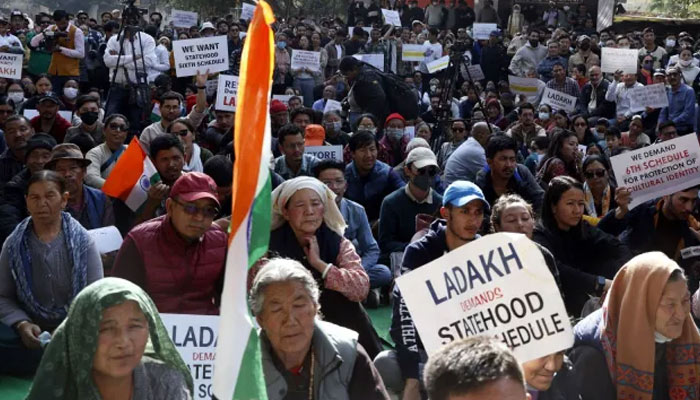
Ladakh Talks End in Deadlock as Centre and Local Leaders Differ Over Legislative Powers
Talks between the Union Home Ministry and representatives of Ladakh ended without a breakthrough on Thursday, with disagreements over the powers of a proposed elected legislature emerging as the main obstacle to a possible agreement. The two sides have agreed to resume discussions in New Delhi on October 22.
The meeting took place months after the Centre proposed introducing a special constitutional provision, referred to as Article 371(K), to provide additional safeguards for Ladakh. Despite the presentation of a draft proposal by the Ministry of Home Affairs (MHA), representatives of the region said significant differences remained between the two sides.
Leaders from the Apex Body Leh (ABL) and the Kargil Democratic Alliance (KDA), which are jointly leading the movement for statehood and Sixth Schedule status, said the Centre’s proposal did not adequately address their principal demands.
“We have not reached any conclusion,” said Chering Dorjay Lakrook, chairman of the ABL. He reiterated that the demand for an elected legislature and constitutional protection under Article 371(K) remained non-negotiable for the regional leadership.
“We stand by our main demands of the legislature and Article 371(K). We don’t allow any dilution in that. We hope that the promises made by the Centre in previous meetings will be fulfilled,” Lakrook said.
Centre’s Draft Fails to Bridge the Gap
Representatives of the ABL and KDA met Home Ministry officials in Leh on Thursday in an attempt to advance negotiations over Ladakh’s proposed governance framework.
According to Lakrook, the ministry presented a draft document running between 15 and 20 pages and explained its provisions through a PowerPoint presentation. The regional representatives also submitted their own proposal, but the two documents reflected substantial differences.
“The Home Ministry submitted its draft proposal. It is a lengthy proposal of 15 to 20 pages. They gave a PowerPoint presentation also. We have also submitted our proposal,” Lakrook said.
He added that the discussions had failed to produce a consensus, although both sides agreed that negotiations should continue without further delay. The next meeting has been scheduled for October 22 in New Delhi.
Sajad Hussain Kargili, co-chairman of the KDA, described the ministry’s draft as “unsatisfactory and unacceptable”. He said the alliance expected to receive a digital copy of the proposal and would examine it before submitting its response by October 18.
Dispute Centres on Powers of Proposed Legislature
The authority and constitutional status of the proposed elected body remain the biggest points of contention.
A senior Ladakh leader who participated in the discussions said the draft did not provide sufficient clarity on several crucial issues, including the name of the proposed institution, the powers available to its ministers, its constitutional validity and the subjects that would fall under its jurisdiction.
These questions are central to determining how much administrative and legislative authority Ladakh’s elected representatives would exercise under the proposed arrangement.
Although both sides have agreed in principle to the creation of an elected legislature, the absence of agreement on its powers has prevented progress towards a final settlement.
Ladakh’s Demand for Greater Political Autonomy
The ABL represents people in Leh, while the KDA represents the interests of residents in Kargil. The two organisations have joined forces to demand statehood and inclusion of Ladakh under the Sixth Schedule of the Constitution.
Their demands gained prominence following the region’s reorganisation in 2019, when the former state of Jammu and Kashmir was divided into two Union Territories, Jammu and Kashmir, and Ladakh. Ladakh became a Union Territory without a legislature.
The Centre has so far not agreed to grant either statehood or Sixth Schedule status. Instead, it has proposed an alternative constitutional arrangement intended to provide safeguards and establish a governance framework suited to the region’s needs.
The proposed Article 371(K) provision is part of those discussions, alongside the plan for an elected Union Territory-level body.
For Ladakh’s representatives, however, the key question is whether the proposed arrangement would provide meaningful decision-making powers or leave major administrative responsibilities with the Centre.
October 22 Meeting May Prove Crucial
Thursday’s inconclusive meeting has left the negotiations at a critical stage. The regional leadership intends to examine the Home Ministry’s written proposal before responding, while both sides have agreed to return to the negotiating table later this month.
The next round of talks is expected to focus on the unresolved provisions governing the proposed legislature and the extent of its authority.
Whether the Centre and Ladakh’s representatives can bridge their differences will determine the future shape of the region’s governance framework. For now, the disagreement over who will control lawmaking and administration continues to stand in the way of a political settlement.
Comments are closed.