
Seifert-Phillips Duo Humble India as New Zealand Clinch 5th T20I by 7 Wickets

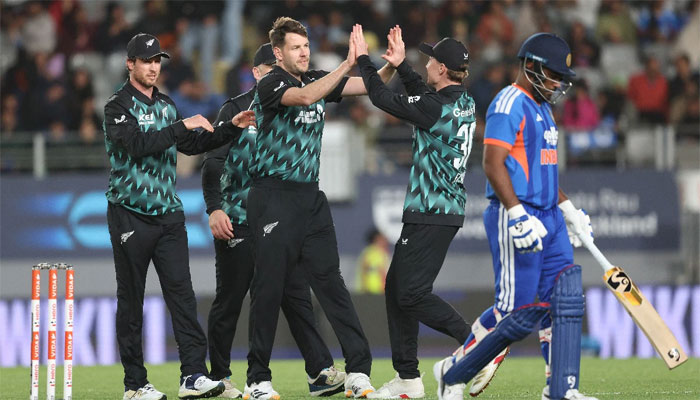
India may have sealed the five-match T20I series, but consecutive defeats in the final two games have exposed several weaknesses in the team, leaving questions over the players’ performances and the management’s approach.
In the fifth and final T20I on Sunday, November 1, Mitchell Santner-led New Zealand handed India a crushing seven-wicket defeat in Hamilton. Tim Seifert was the star of the chase, smashing 93 runs off just 50 deliveries as the hosts comfortably reached the target of 192 in 18 overs.
India Struggle After Losing the Toss
For the first time in the series, India lost the toss and were asked to bat. The decision immediately put the visitors under pressure as New Zealand’s seamers exploited the fresh conditions at Seddon Park.
India’s innings got off to a disastrous start. Abhishek Sharma departed in the opening over after mistiming a shot off Jacob Duffy, while Sanju Samson soon followed, edging Michael Bracewell to the covers.
Samson’s dismissal marked another disappointing outing in a series in which he had managed just one significant contribution — his 67-run knock in the opening match. His repeated failures also raised questions about the decision to leave young Vaibhav Sooryavanshi out of the playing XI, even with the series already decided.
With two early wickets down, Ishan Kishan and Shreyas Iyer took responsibility for rebuilding the innings. The pair counterattacked effectively, combining sensible batting with aggressive stroke play to put the Indian innings back on track.
Kishan was particularly impressive, taking on both the fast bowlers and spinners before completing his half-century in just 28 balls. Iyer provided equally valuable support, helping India reach 111/2 at the halfway stage.
However, New Zealand struck back after the drinks break. Blair Tickner and Nathan Smith removed both set batters, shifting the momentum back towards the hosts.
India’s lower order managed to keep the scoreboard moving, although New Zealand’s fielding lapses also helped the visitors post a competitive total. Fielding has been a recurring concern for the hosts throughout the series, something they will need to address ahead of the 2028 T20 World Cup.
Adam Milne led the bowling attack with an outstanding spell, claiming four wickets for just 19 runs in his four overs. Tickner and Smith chipped in with two wickets each as India finished at 191/8.
Tim Seifert and Glenn Phillips Demolish India’s Bowling
Chasing 192, New Zealand barely allowed India to settle into the contest. Apart from Finn Allen’s early dismissal in the second over, the hosts controlled the chase with remarkable ease.
Seifert took charge from the outset, attacking the Indian bowlers and maintaining an impressive scoring rate. He received valuable support from Daryl Mitchell, who contributed 29 runs off 16 balls, and Glenn Phillips, who continued his excellent form after scoring a century in the previous match.
Seifert’s explosive 93 off 50 deliveries put New Zealand firmly in control, leaving India with very few opportunities to fight their way back into the contest.
Phillips then ensured there would be no late drama. He struck two consecutive boundaries in the 18th over, finding gaps between fine leg and third man to complete the chase and seal a seven-wicket victory.
India’s Team Selection and Experimentation Under Scrutiny
Although India won the series convincingly, the defeats in the last two matches have raised important questions about the team’s approach.
With the 2028 T20 World Cup still some distance away, bilateral series offer an ideal opportunity to test combinations, give younger players opportunities and assess alternatives under pressure.
The decision to stick with established players despite repeated failures, particularly in a dead rubber, is likely to invite scrutiny. India’s management will need to consider whether it is making enough room for experimentation or allowing the fear of losing individual matches to influence selection decisions.
The series victory remains a positive result, but the final two performances have offered India plenty to think about.
Comments are closed.