
Quad Raises Alarm Over China’s Growing Influence On Indo-Pacific Supply Chains

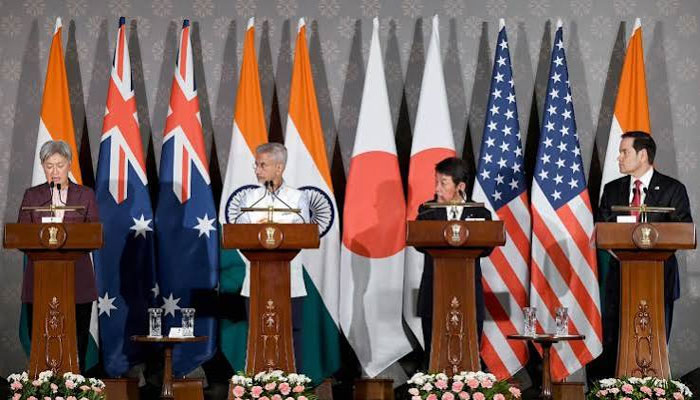
The Quad has made supply-chain resilience a major priority in its latest Indo-Pacific strategy, raising concerns over economic coercion, export controls and trade practices that could threaten critical industries.
Although China was not directly mentioned in the group’s joint statement, the concerns appear closely linked to Beijing’s growing influence over strategic resources, particularly critical minerals and rare earth elements.
At a meeting held in Atlanta on October 31, foreign ministers from the United States, India, Japan and Australia stressed the need to develop reliable and transparent global supply chains while strengthening resilient infrastructure across the Indo-Pacific.
The four countries also expressed concerns about arbitrary export restrictions and non-market policies that contribute to excess production capacity and disrupt international trade. The statement comes amid increasing tensions over China’s restrictions on critical mineral exports and Washington’s efforts to reduce dependence on Chinese-controlled resources.
China’s Dominance Over Critical Minerals Raises Concerns
The growing concentration of mineral processing in China has emerged as a major concern for the Quad countries.
According to the International Energy Agency (IEA), China accounts for approximately 70-75% of global lithium and cobalt processing. Its share in the refining of rare earth elements and battery-grade graphite exceeds 90%.
Such overwhelming control over essential materials creates vulnerabilities for global industries. Any disruption in supplies from a major producer could affect manufacturing, technology development, electric vehicle production and other strategic sectors.
Japan has already raised concerns over Chinese restrictions on critical mineral exports, while the United States has been working with international partners to develop alternative sources of supply.
Quad Looks For Alternatives To Chinese Supply Chains
To address these vulnerabilities, the Quad is pursuing initiatives aimed at diversifying critical mineral supplies and strengthening regional capabilities.
Under its Critical Minerals Initiative, announced in May, the four countries are exploring ways to recover valuable materials from electronic waste and industrial scrap.
During the Atlanta meeting, the United States also announced a commitment of $10 million towards infrastructure and facilities in India and ASEAN countries to support critical mineral recovery from waste.
The initiative is expected to encourage recycling, reduce dependence on concentrated supply sources and create more resilient regional supply networks.
AI And Semiconductor Supply Chains Also In Focus
Beyond minerals, the Quad is increasing its focus on emerging technologies and semiconductor security.
The four countries pledged more than $85 million in technical and financial assistance to promote trusted artificial intelligence across the Indo-Pacific.
They also announced plans to identify weaknesses in semiconductor and related technology supply chains before disruptions affect critical industries.
The move reflects growing recognition that access to advanced technology, semiconductor components and essential raw materials is becoming increasingly important for both economic competitiveness and national security.
Is China The Unspoken Target Of The Quad?
Despite the strong language on economic coercion and export restrictions, the Quad has avoided officially identifying China as the target of its latest initiatives.
US Secretary of State Marco Rubio clarified that the grouping was not an ‘anti-China’ coalition. However, he also suggested that the concerns highlighted in the joint statement reflected practices repeatedly associated with one particular country.
This carefully worded approach indicates that the Quad wants to address supply-chain vulnerabilities without turning its broader Indo-Pacific cooperation into an explicitly anti-China alliance.
The larger objective is to reduce excessive dependence on a single country for essential resources and technologies. As competition intensifies over rare earths, critical minerals, semiconductors and artificial intelligence, supply-chain diversification is increasingly becoming a central pillar of the Quad’s economic and strategic agenda.
Comments are closed.