
Spain Sees Massive Housing Protests in Barcelona and Madrid as Workers Launch Nationwide Strike Ahead of Elections

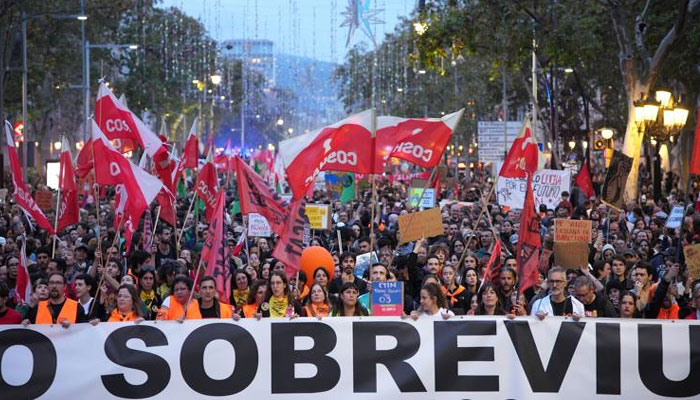
Spain Gripped by Nationwide Strike as Housing Crisis Triggers Mass Protests in Barcelona, Madrid
Spain witnessed widespread disruption on Wednesday as workers across the country joined a nationwide general strike over rising housing costs, soaring rents and the growing difficulty of buying property. Businesses and public transport services were affected, while thousands of demonstrators gathered in major cities, including Barcelona and Madrid.
The protest, organised under the slogan ‘Salaries. Housing. Prices.’, marked Spain’s first general strike in 14 years. It was also the first nationwide labour action in which housing affordability emerged as the central demand.
Housing campaigners want stronger tenant protections, tighter controls on property speculation and measures to make accommodation more affordable. The demonstrations have also become politically significant, coming just weeks before Spain’s November 29 national election, with Prime Minister Pedro Sánchez’s left-wing coalition facing a challenging electoral contest.
MASSIVE TURNOUT IN BARCELONA AND MADRID
Barcelona witnessed some of the largest demonstrations. Housing activists estimated that around 400,000 people participated, while the city administration put the turnout at approximately 55,000.
On Paseo de Gracia, one of the city’s prominent shopping avenues, several stores had boarded up their premises ahead of the demonstrations. Thousands of protesters marched behind banners carrying messages such as ‘Live. Not Just Survive.’
Although the main march remained peaceful, some demonstrators later damaged the windows of luxury retail outlets. Police in riot gear arrived at the scene to control the situation.
Public transportation was also disrupted, with Barcelona’s metro and buses operating only outside rush-hour restrictions.
In Madrid, thousands braved heavy rainfall to participate in an evening march along Paseo del Prado. Earlier, demonstrators had blocked Gran Vía, prompting police to intervene and move protesters towards the pavements. Some clashes were reported, with police using pepper spray at certain locations.
UNIONS CLAIM STRIKE SUCCESS, BUSINESS GROUPS DISAGREE
The country’s two major labour organisations, CCOO and UGT, described the industrial action as a significant success, reporting substantial participation across several key sectors.
According to union figures, work stoppages reached 90 per cent in the automotive and port industries, 85 per cent in the meat-processing sector, 82 per cent in waste collection and 75 per cent in energy.
Several schools and universities also remained closed, while approximately 5 per cent of scheduled flights were cancelled across Spanish airports, according to airport operator AENA.
However, business associations disputed the unions’ assessment, arguing that participation was considerably lower in retail, restaurants and other service industries.
Madrid’s regional government, led by the conservative Popular Party, also dismissed the strike as unsuccessful, claiming that only 9 per cent of public-sector employees in the region participated.
Police reported 29 arrests across the country in connection with strike-related incidents, including nine in Madrid. Earlier disruptions included burning tyres at roadblocks in Barcelona and confrontations near Madrid’s main wholesale market.
HOUSING AFFORDABILITY BECOMES A NATIONAL ISSUE
The growing public anger reflects Spain’s worsening housing affordability crisis. Average rents have nearly doubled over the past decade, placing increasing pressure on household finances and making homeownership increasingly difficult for many residents.
The eviction of an 87-year-old woman, Maricarmen, from her Madrid home last month further intensified public outrage. Her subsequent death turned her into a symbol of the housing insecurity affecting vulnerable residents.
The Tenants Union used the incident to mobilise support for nationwide demonstrations, eventually securing backing from major labour organisations.
Housing activists are demanding automatic lease renewals and stronger safeguards for tenants. Trade unions are also pressing the government to expand public housing and negotiate a new minimum-wage agreement.
HOUSING CRISIS ADDS TO SPAIN’S ELECTION BATTLE
The demonstrations have taken on added political importance ahead of the November 29 general election. Sánchez and his Socialist allies are seeking to keep housing and social welfare at the centre of the national debate.
The government’s campaign has also faced challenges following a deadly high-speed train collision in October that killed 69 people, marking Spain’s second fatal rail disaster of the year.
Political analyst Oriol Bartomeus of the Autonomous University of Barcelona said the strike could give left-wing parties an opportunity to redirect the election campaign towards housing affordability, provided the demonstrations remained peaceful.
Meanwhile, the opposition Popular Party and far-right Vox have accused unions of attempting to strengthen Sánchez’s electoral position.
The outcome of the protests could therefore influence the political narrative in the final weeks before voting, particularly as housing costs, workers’ wages and public services remain central concerns for Spanish voters.
Comments are closed.