

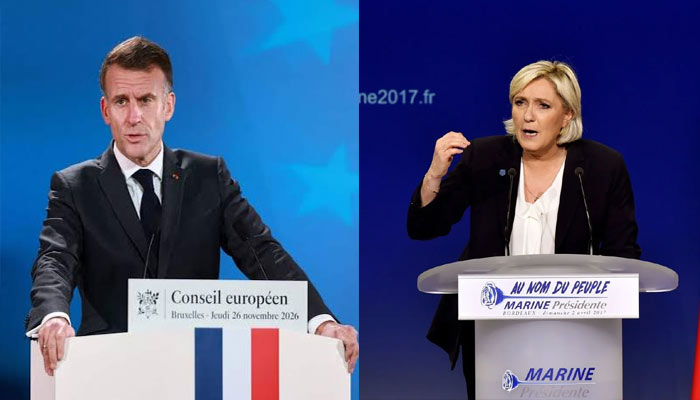
Macron Hits Back at Marine Le Pen Over EU Budget Row Ahead of France’s 2027 Elections
French President Emmanuel Macron and far-right leader Marine Le Pen have exchanged sharp remarks over negotiations on the European Union’s next long-term budget, with disagreements over the timing of an agreement becoming entangled with France’s upcoming 2027 presidential election.
Macron criticised Le Pen on Thursday, accusing her of displaying arrogance after she opposed efforts to finalise the EU’s 2028-2034 budget before French voters head to the polls. The exchange came after a Brussels summit ended without a breakthrough following more than 12 hours of discussions among European leaders.
German Chancellor Friedrich Merz acknowledged that significant differences remained, although he said he had not abandoned hopes of reaching an agreement when leaders meet again on December 17.
The failure to make progress has raised the possibility that negotiations could extend into a politically sensitive election period across Europe, particularly in France. Macron has indicated that he could withdraw from the process if an agreement is not reached within the expected timeframe.
Macron Accuses Le Pen of Political Arrogance
Le Pen, who is considered a leading contender to succeed Macron in the 2027 presidential election, criticised the attempt to settle the budget before the French vote.
In a social media post, she described the initiative as an attempt at political manoeuvring designed to prevent French voters from having a say in decisions affecting the country’s future.
Responding to her criticism on the sidelines of the Brussels summit, Macron said Le Pen was behaving as though she already controlled France’s political destiny, despite not having been elected president.
The latest confrontation follows another exchange last month, when Macron urged Le Pen to remain humble after she outlined proposals to reduce France’s financial assistance to Ukraine and its contribution to the European Union.
EU Leaders Divided Over Seven-Year Budget
European leaders have spent much of 2026 debating the size and priorities of the bloc’s proposed 2028-2034 budget. The European Commission initially presented a spending plan worth approximately two trillion euros, drawing objections from several member states.
European Council President Antonio Costa subsequently proposed reducing the package by 204 billion euros, equivalent to around $224 billion, alongside a possible tax on digital companies. However, the revised proposal failed to bridge the differences among member states.
Germany and the Netherlands, along with five other countries grouped under the name ‘Sensible Seven’, are pushing for tighter spending limits and a smaller overall budget.
Merz reiterated Germany’s demand for spending cuts after the summit, while several countries aligned with Berlin skipped the final discussions to express their dissatisfaction.
On the other side, 17 southern, central and eastern European countries belonging to the ‘Friends of Cohesion’ group are seeking stronger financial commitments for agricultural support and regional development. Their position has also received backing from farmers who demonstrated outside the summit venue.
Costa described the meeting as an important stage in the negotiations, despite the absence of an agreement. An EU diplomat suggested that several leaders had used the discussions to publicly demonstrate their political positions.
Macron Warns Against Reducing EU Spending
France has opposed substantial reductions in the proposed budget, arguing that European countries require greater financial resources to address growing economic and geopolitical challenges.
Macron described significant budget cuts as a strategic mistake, warning that they could weaken Europe’s ability to compete with major economies such as China and the United States.
The French president’s position has also become linked to the possibility of Le Pen gaining power next year. One EU diplomat acknowledged that the potential consequences of a change in France’s leadership remained an important consideration during the negotiations.
However, Austrian Chancellor Christian Stocker dismissed concerns about the French election, while Italian Prime Minister Giorgia Meloni argued that there was no firm deadline requiring an immediate budget agreement.
Ukraine Funding Adds Another Complication
The budget negotiations have become more complicated after Merz connected progress on the long-term spending plan with an agreement on additional financial assistance for Ukraine.
EU member states are being asked to approve an additional 45-billion-euro loan, worth approximately $49 billion, to support Ukraine through 2027.
However, the Czech Republic, Hungary and Slovakia have sought exemptions from the proposed arrangement. The three countries had also opted out of a similar large-scale loan package last year.
Merz rejected the possibility of allowing individual countries to avoid contributing, insisting that support for Ukraine should be a collective responsibility shared by all 27 EU members.
With major disagreements continuing over spending priorities, agricultural funding, Ukraine assistance and the timing of an agreement, European leaders face difficult negotiations ahead of their next meeting on December 17.
Comments are closed.