
Blue Origin sends first wheelchair user, five others on space tourism flight

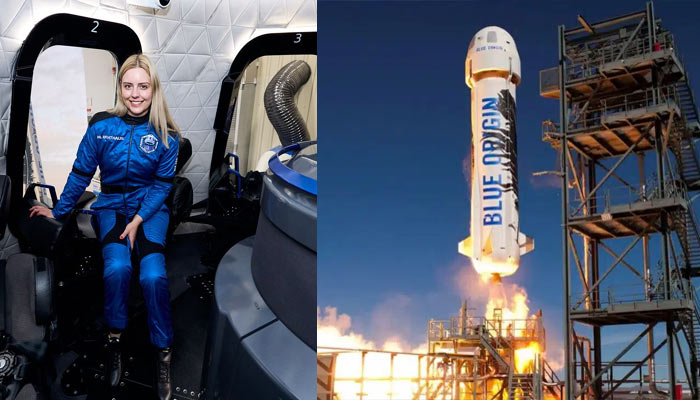
Jeff Bezos-led Blue Origin on Saturday launched the world’s first wheelchair user to space, marking a landmark moment for commercial spaceflight and disability inclusion.
The New Shepard NS-37 mission lifted off from Blue Origin’s Launch Site One in West Texas, carrying German aerospace engineer Michaela “Michi” Benthaus and five other private passengers on a brief suborbital flight beyond the Kármán line — the 100-kilometre boundary widely recognised as the edge of space.
The launch had originally been scheduled for Thursday but was scrubbed due to technical issues and high winds in the launch area.
The fully reusable New Shepard rocket-capsule system completed a roughly 10–12 minute journey from liftoff to landing, giving the crew several minutes of microgravity and panoramic views of Earth against the blackness of space.
First wheelchair user in space
Benthaus, who works with the European Space Agency and has used a wheelchair since a spinal cord injury sustained in a mountain-biking accident in 2018, became the first person who uses a wheelchair to cross into space.
Her participation has been widely hailed by disability advocates and space professionals as a breakthrough moment, reinforcing that physical disabilities need not be a barrier to spaceflight.
“I was a very sporty person, but my life changed after the accident. I realised how inaccessible the world still is,” Benthaus said ahead of the mission. “It turns out a disabled person can be an astronaut. If we want to be an inclusive society, we should be inclusive in every part of life.”
Diverse crew onboard
Benthaus was joined by investors Joey Hyde and Adonis Pouroulis, former SpaceX executive and aerospace engineer Hans Koenigsmann, entrepreneur Neal Milch, and computer scientist Jason Stansell.
The six-member crew travelled inside New Shepard’s pressurised capsule, designed with large windows and features to support safe movement during short periods of weightlessness.
NS-37 marked Blue Origin’s 37th New Shepard mission and the 16th to carry humans, taking the total number of people flown by the system to more than 80.
Expanding access to space
The mission underscores Blue Origin’s efforts to position suborbital tourism as a gateway to space for a broader and more diverse group of people, even as the company continues to keep ticket prices undisclosed.
For advocates of inclusive design, Benthaus’s flight serves as a proof of concept that spacecraft can be engineered to accommodate a wider range of physical abilities from the outset.
The capsule landed safely in the Texas desert after approximately 11 minutes, bringing the historic flight to a successful conclusion.
Comments are closed.