
Cristiano Ronaldo’s Quiet Display Highlights Portugal’s Biggest World Cup Concern

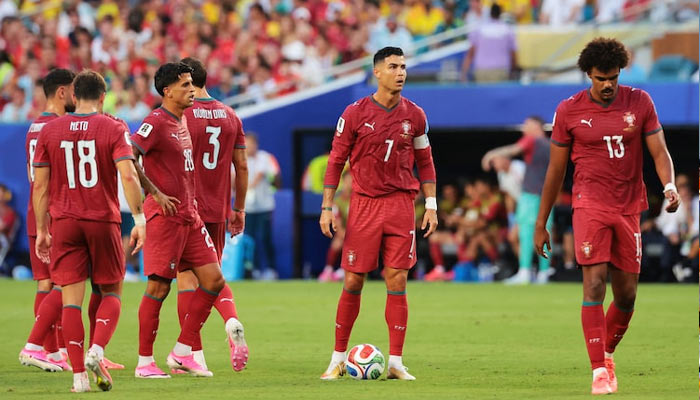
Cristiano Ronaldo Left Waiting as Portugal’s Midfield Problems Surface in Colombia Stalemate
Just three days after becoming the first footballer to score in six different FIFA World Cups, Cristiano Ronaldo endured a frustrating evening as Portugal were held to a goalless draw by Colombia in their final Group K fixture.
The contrast could hardly have been starker. Against Uzbekistan, Ronaldo had once again demonstrated his enduring predatory instincts. In Miami, however, Portugal’s captain was largely reduced to waving for passes that rarely arrived, pointing towards open spaces that teammates failed to exploit and watching attacks break down before they ever reached him.
Portugal progressed to the Round of 32 as Group K runners-up, where they will face Croatia, while Colombia topped the group after producing the more convincing display and earned a clash with Ghana. In the night’s other fixture, DR Congo fought back from behind to beat Uzbekistan 3-1 and secured one of the best third-placed qualification spots, setting up a meeting with England.
Although Portugal advanced, the performance exposed concerns that extend well beyond one disappointing result.
Colombia Controlled the Contest
The 0-0 scoreline masked a game largely dictated by Colombia. Nestor Lorenzo’s side created the better opportunities, attempted 24 shots compared to Portugal’s 13 and repeatedly tested goalkeeper Diogo Costa, who produced six crucial saves to preserve the draw.
Colombia even believed they had found a dramatic stoppage-time winner when Davinson Sanchez headed home, only for VAR to confirm the defender had been offside.
Without Costa’s outstanding display, Portugal could easily have suffered their first defeat of the tournament.
Portugal’s Midfield Failed to Connect
Portugal possess one of the tournament’s most gifted collections of midfielders. Bruno Fernandes, Vitinha, Ruben Neves and Joao Neves offer creativity, control and technical excellence, while Joao Felix and Pedro Neto provide attacking variety.
Yet against Colombia, those qualities rarely came together.
Portugal struggled to progress the ball through midfield with any consistency. Bruno Fernandes frequently dropped deep simply to receive possession, Vitinha found little influence on the tempo of the match, and attacks repeatedly slowed before reaching dangerous areas.
Rather than moving with clear patterns and combinations, Portugal often appeared uncertain about their next pass. Possession was recycled sideways instead of progressing quickly into advanced positions, leaving Ronaldo increasingly isolated inside the penalty area.
The captain’s visible frustration reflected the team’s broader issues. He repeatedly gestured for earlier crosses and more direct service but received few opportunities to attack deliveries in the box—precisely the approach that had worked so effectively against Uzbekistan.
- The problem was not Ronaldo’s movement.
- It was Portugal’s inability to consistently supply him.
- Tactical Questions for Roberto Martinez
Portugal’s reliance on moments of individual brilliance has become increasingly noticeable under Roberto Martinez.
When players such as Ronaldo, Bruno Fernandes or Rafael Leao produce something extraordinary, Portugal can overwhelm opponents. Against a disciplined and organised Colombia, however, those moments were scarce, exposing the lack of a consistent attacking structure.
Too often, Portugal’s players appeared to improvise after receiving possession rather than execute rehearsed patterns of play. For a squad blessed with such technical quality, the absence of a clear attacking identity remains a concern heading into the knockout rounds.
Croatia Present a Tougher Test
Portugal now face Croatia in the Round of 32—a side unlikely to be as forgiving if similar problems persist.
With Luka Modric and Mateo Kovacic controlling midfield, Croatia possess the quality to dominate possession and punish teams that surrender control in central areas. If Portugal once again struggle to connect midfield with attack, Ronaldo may find himself feeding on scraps for a second consecutive match.
The draw also altered Portugal’s route through the knockout stages. By finishing second, they moved to the opposite side of the bracket from Argentina, meaning a long-anticipated World Cup meeting between Cristiano Ronaldo and Lionel Messi can now only happen if both nations reach the final.
For now, though, Portugal’s attention must remain much closer to home.
Because before dreaming of a historic showdown with Argentina, Roberto Martinez’s side must first rediscover the attacking cohesion that deserted them against Colombia.
Comments are closed.