
Decoded: Why Mamata Banerjee Is in the Supreme Court in the Bengal SIR Case

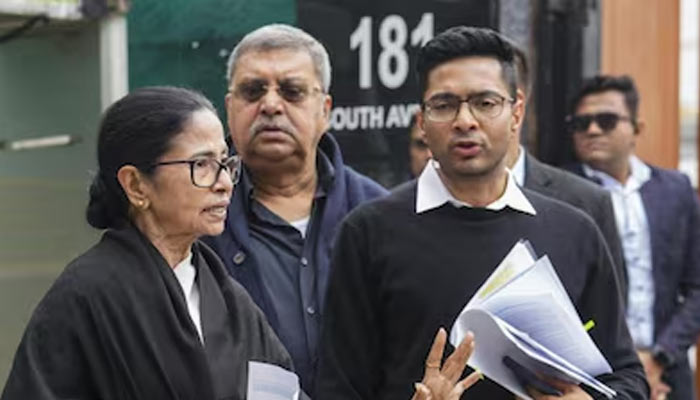
West Bengal Chief Minister Mamata Banerjee on Wednesday made history by personally arguing a case in the Supreme Court as a “common citizen”, challenging the Election Commission’s special intensive revision (SIR) of electoral rolls in the state.
Dressed in a black lawyer’s coat over her trademark white saree, Banerjee waited for more than two hours at the back of a courtroom presided over by Chief Justice Surya Kant before making an impassioned intervention. In her characteristic fiery style, she accused the poll panel of inflicting “unprecedented hardship and distress” on ordinary citizens across Bengal.
“Justice is crying behind closed doors,” she told the court, claiming the people of Bengal had been denied fairness in the voter revision exercise. She said she had written six letters to the Election Commission but received no response.
While Banerjee sought five minutes to present her case, the Chief Justice allowed her 15 minutes, noting the gravity of the issues raised.
Why Mamata Banerjee moved the Supreme Court
Banerjee’s principal plea was that the voter lists for the upcoming March–April elections should be prepared using data from 2005, rather than the ongoing 2026 SIR. She argued that the rapid revision had led to the exclusion of lakhs of legitimate voters, many of whom, she alleged, traditionally vote against the BJP.
She accused the Election Commission of acting under pressure from the ruling party at the Centre — a charge echoed by opposition parties in other states.
“A process that normally takes two years — how can it be completed in three months?” she asked. “Why is Bengal being targeted? Why is this not happening in Assam?”
Banerjee also objected to the deployment of 8,300 micro-observers across the state, branding them “BJP officers” and calling their appointments unconstitutional.
‘Logical discrepancy’ and voter deletions
A major point of contention was the deletion of voters on the grounds of so-called “logical discrepancies”, including mismatches in biographic details such as spelling errors or changes in surnames.
Banerjee said around 63 lakh voters were facing exclusion on this basis. She cited media reports of voters being struck off due to minor spelling variations, name changes after marriage, or address changes linked to migration for work.
“Even daughters who move to their in-laws’ homes are being deleted,” she said, calling the practice arbitrary and unjust.
The court observed that spelling inconsistencies were common when Bengali names were transliterated into English, noting examples such as Datta and Dutta, and said such discrepancies could not be grounds for deletion.
Banerjee urged the court to direct the Election Commission to automatically restore voters excluded for “logical discrepancy” without requiring personal hearings.
She also sought directions for the poll panel to publish — on its website and in machine-readable format — the names of the 1.4 crore voters removed from the rolls, and to accept Aadhaar as valid proof of identity.
Allegations against the Election Commission
Accusing the poll panel of poor communication, Banerjee derided it as a “WhatsApp Commission”, alleging notices were being sent digitally, forcing citizens to stand in queues for hours to resolve discrepancies.
She also raised concerns over the deaths of booth-level officers (BLOs), claiming more than 100 had died due to pressure linked to the SIR exercise, with many others hospitalised.
“Why is this pressure not being applied in Assam or the northeast?” she asked, alleging Bengal was being selectively targeted.
Submissions by lawyers
Senior advocate Shyam Divan, appearing for Banerjee, told the court that only four days remained before publication of the final electoral rolls, while over 1.36 crore people flagged for “logical discrepancies” had yet to be heard.
“It is impossible to complete this exercise within the deadline,” he said, adding that the Election Commission had not disclosed reasons for placing voters on the discrepancy list.
Appearing for the Election Commission, senior advocate Rakesh Dwivedi said micro-observers had been appointed because the state government failed to provide sufficient officers for the SIR despite repeated reminders.
What the court said
Terming the issues raised by Banerjee “genuine”, the Supreme Court issued notice to the Election Commission and sought its response by Monday.
On the issue of micro-observers, the bench said they could be withdrawn if the state provided a list of officers who could be spared for SIR duties.
The Chief Justice also directed the Election Commission to act in a “sensible manner” while issuing notices for minor spelling errors, citing cases involving Nobel laureate Amartya Sen, poet Joy Goswami, and Trinamool MP Dipak Adhikari.
Solicitor-General Tushar Mehta told the court there was an “atmosphere of hostility” towards Election Commission officials in Bengal and sought to tag the matter with a separate plea seeking protection for poll officials. The court agreed to list that petition on Monday.
Comments are closed.