
European Super League Project Finally Collapses After Legal Truce Between UEFA and Real Madrid

RIP European Super League: Football’s Most Controversial Experiment Finally Ends
A line from Ted Lasso once joked about the emotional chaos of football. In April 2021, it suddenly didn’t feel funny. For a brief, chaotic moment, the sport felt under threat, as if someone could redesign it overnight without asking the people who actually live and breathe it: the fans.
Out of nowhere, twelve of Europe’s biggest clubs announced the European Super League. This wasn’t a midweek experiment or a harmless addition to the Champions League—it was a closed league designed to protect the richest clubs from failure, ensuring permanent spots at the top regardless of performance.
It was sold as progress, a way to “raise the level” of elite football. But supporters heard something else entirely: a VIP-only gate around a game built on openness. The same clubs would cash in regardless of results, while everyone else was left out.
Football has always been messy, unfair, and chaotic—but one rule has always been sacred: the biggest competitions are earned, not handed out. The Super League threatened to rip that away.
Now, even that final resistance is gone. Real Madrid, the last club tied to the project, has reached a peace deal with UEFA and the European Club Association, officially ending the saga. “This agreement in principle will also serve to resolve their legal disputes related to the European Super League, once a final agreement is implemented,” the statement said.
The Super League was born as much from fear as greed. The pandemic had bruised club finances, and owners sought guaranteed revenue every season. Their solution? A closed shop where fifteen founding clubs never really had to qualify, where results mattered less than reputation and commercial pull. Football was being redesigned as a private members’ club instead of a merit-based sport.
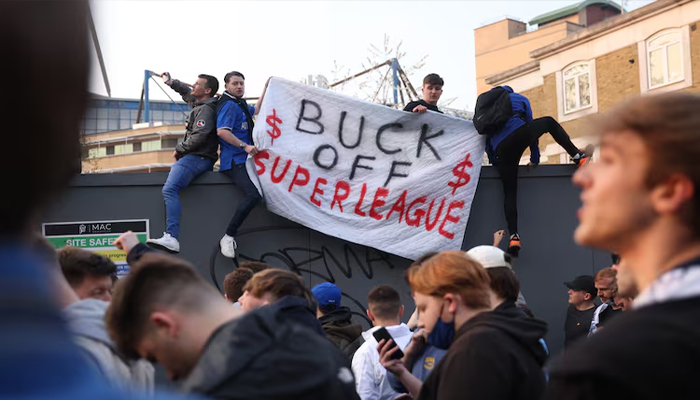
But the Super League didn’t collapse in court—it fell on the streets. Fans erupted instantly, understanding that the core of football was at stake. Protests flared across England: Chelsea fans blocked buses, Liverpool supporters called it betrayal, Manchester United fans stormed Old Trafford. Within 72 hours, the Premier League’s Big Six withdrew, followed by the Italian clubs, leaving only Real Madrid and Barcelona clinging to the idea.
Florentino Perez became the last guardian of the dream, insisting that football needed saving. Yet, over time, allies drifted away, and his vision of a new football order collapsed. The Super League lingered as a ghost—legal drama, not reality. Now, with Madrid making peace with UEFA, the experiment is over.
The Super League struck at football’s soul. It tried to rewrite the oldest rule: success is earned, not gifted. Domestic leagues would have fractured, inequality widened, and competition turned into privilege. Fans weren’t resisting change—they were protecting the essence of the game.
The good news? Supporters still matter. For once, terraces had the final word. Clubs folded, the idea crumbled, and football reminded everyone that glory is meant to be chased—not reserved.
Comments are closed.