
From SIR Protests to Congress-CJP Unity and UP Polls: BJP Faces Multiple Political Challenges

SIR Row, Congress-CJP Bonhomie and UP Polls: Why BJP Faces Growing Political Challenges
The growing protests against Chief Election Commissioner (CEC) Gyanesh Kumar over the Special Intensive Revision (SIR) of electoral rolls, coupled with improving ties between the Congress and the Cockroach Janta Party (CJP), have added to the political challenges facing the ruling Bharatiya Janata Party (BJP). With crucial Assembly elections approaching in states such as Uttar Pradesh and Punjab, the Opposition’s renewed unity is emerging as a concern for the party.
Several BJP leaders acknowledge that the growing unrest, particularly among young people, goes beyond opposition to the CEC or the SIR exercise. They believe the demonstrations reflect wider public concerns over inflation, unemployment and rural distress, compounded by market volatility and global economic uncertainties.
What has particularly unsettled the BJP, according to party sources, is the increasing visibility of the protests and the strategic advantage they appear to be providing the Opposition.
The BJP’s recent electoral successes, including its performance in Gujarat’s local body elections, have received less attention amid the nationwide debate surrounding the SIR controversy. Party insiders believe that the Opposition’s campaign, amplified through social media, has managed to dominate the political narrative.
Although BJP leaders maintain that the protests have not significantly altered ground realities or weakened Prime Minister Narendra Modi’s popularity, some fear that the campaign could raise doubts among voters about the credibility and integrity of the electoral process.
Opposition Unity Gives INDIA Bloc a Boost
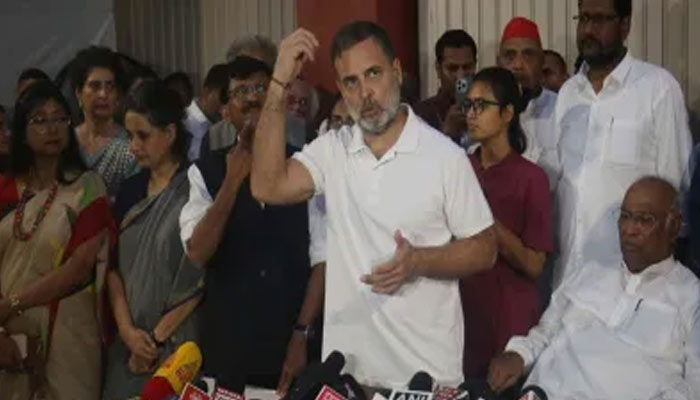
The INDIA bloc has gained fresh momentum as the Congress increasingly stresses the importance of opposition unity. Leader of Opposition Rahul Gandhi’s public support for CJP leaders has further highlighted the emerging political understanding between the two parties.
On Wednesday, Rahul criticised the Modi government after CJP leaders Saurav Das and Ashutosh Ranka were sent to judicial custody. In a post on X, he said: “Waving the Tricolour at Jantar Mantar in a peaceful protest is not a crime. Jailing youth for it is an act of cowardice.”
CJP founder Abhijeet Dipke responded by thanking Rahul for speaking out against what he described as the illegal arrest of his colleagues.
The exchange underscored the growing cooperation between opposition parties over the SIR controversy, potentially giving the INDIA bloc a stronger platform to challenge the BJP.
Several Opposition leaders in Delhi have described their protests as successful in attracting public attention. However, they also recognise that sustained political mobilisation will be necessary to convert the visibility into electoral gains.
BJP Sees Unemployment, Inflation and Rural Distress as Larger Concerns
Despite dismissing the demonstrations as a social media-driven campaign aimed at gaining attention, BJP leaders concede that the protests reflect broader frustrations among different sections of society.
A senior BJP MP argued that the party’s experience in Bihar suggested that the Opposition’s campaign over alleged vote theft had not significantly influenced voters. However, the MP acknowledged that economic concerns could create a more complicated political environment.
Young people remain worried about employment opportunities, particularly amid global economic uncertainty. The middle class is concerned about volatile financial markets and the possibility of investment losses, while rising prices continue to put pressure on household budgets. Rural communities, meanwhile, are grappling with their own set of economic difficulties.
The BJP leader suggested that the Opposition’s concentration on the SIR issue could temporarily benefit the ruling party by diverting attention from these broader concerns. The ongoing festival season was also expected to reduce public interest in the demonstrations.
However, the party expects the Opposition to use the Winter Session of Parliament, anticipated to begin in the third week of November, to raise questions about the economy, governance and electoral reforms.
A senior BJP leader indicated that the party could launch a campaign to address public concerns and clarify doubts surrounding the SIR exercise.
Opposition Unity Complicates BJP’s Legislative Agenda
The changing political equations have also created difficulties for the government’s legislative priorities.
One significant setback came in April, when the constitutional amendment Bill seeking to advance the implementation of women’s reservation to 2029, alongside a proposed delimitation Bill that would expand the Lok Sabha’s strength from 543 seats to as many as 850, was defeated in the Lok Sabha during a special session.
Two other important legislative proposals remain pending.
The 130th Constitution Amendment Bill proposes the automatic removal of ministers who are arrested or detained for more than 30 days in connection with serious offences. Meanwhile, the Viksit Bharat Shiksha Adhishthan Bill, 2025, seeks to restructure the country’s higher education regulatory framework.
Joint parliamentary committees examining the proposals have been unable to finalise their reports because of disagreements among political parties.
A BJP insider observed that the Opposition had been divided into multiple groups when the Monsoon Session began on July 20, but its current cooperation presents a different challenge. The source acknowledged that the improved coordination among opposition parties could complicate the government’s legislative plans.
Cabinet Reshuffle May Be an Option Ahead of Elections
Political developments within the government have added another dimension to the BJP’s preparations for the upcoming electoral battles.
The resignation of Union minister L. Murugan from both the Union Council of Ministers and the Rajya Sabha has fuelled speculation about a possible Cabinet reshuffle.
Some BJP leaders believe that introducing new faces and refreshing the ministerial team could help the government regain political momentum and improve its public image ahead of the Assembly elections scheduled for February 2027.
With the SIR controversy dominating political discussions, opposition parties increasingly coordinating their campaigns and economic concerns continuing to trouble sections of the electorate, the BJP faces a multifaceted challenge.
The immediate task for the ruling party will be to counter the Opposition’s narrative, restore confidence in the electoral process and prevent the growing public discontent from becoming a wider political liability. Whether the INDIA bloc can sustain its current unity and translate its campaign into votes will be equally important in determining the political outcome of the coming electoral cycle.
Comments are closed.