

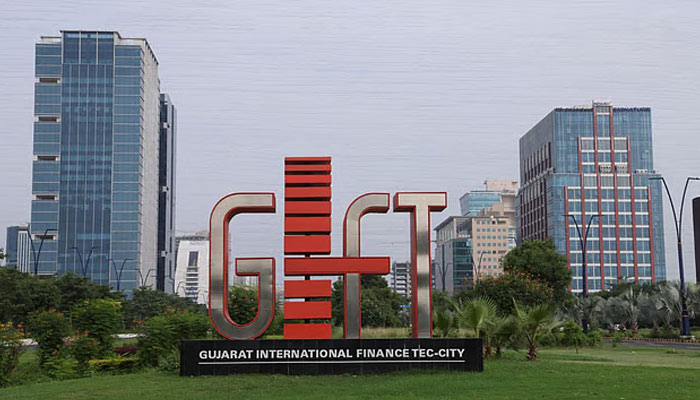
As Indian equities struggle to keep pace with major global markets, a growing number of retail investors are turning to international investment options through Gujarat International Finance Tec-City (GIFT City).
Data from the International Financial Services Centres Authority (IFSCA) shows that the number of investors in retail-oriented international schemes jumped to 8,467 in the April-June quarter, from 3,483 in the previous quarter.
The surge also marked a significant shift in GIFT City’s fund management ecosystem. Retail investors accounted for more than 52% of the total investors in such international funds, becoming the largest investor segment for the first time.
By comparison, alternative investment funds (AIFs) had 7,683 investors during the quarter, a 26% rise from the previous quarter. However, their share of the overall investor base declined from nearly 64% earlier.
Market professionals say the growing appetite for overseas exposure is being driven partly by the stronger performance of global equities compared with Indian markets.
“Global markets have done exceedingly well compared to Indian markets, and Indian investors have understood the importance of global diversification, and hence participation from retail investors has increased,” said Vaibhav Shah, head of products, business strategy and international business at Mirae Asset Mutual Fund.
Shweta Rajani, head of mutual funds at Anand Rathi Wealth, said the trend was also being supported by easier access to overseas investments from India and greater clarity on taxation for retail schemes and ETFs.
GIFT City offers investors an alternative route to gain exposure to markets such as the US and other emerging economies without having to directly open accounts or invest overseas. The Gujarat-based International Financial Services Centre (IFSC) also offers tax and regulatory advantages aimed at attracting global financial activity.
IFSC funds are regulated by the International Financial Services Centres Authority, while overseas fund-of-funds (FoFs) in India fall under the Securities and Exchange Board of India (SEBI).
The regulatory framework has become particularly relevant as Indian mutual funds face limits on overseas investments. The industry-wide cap for mutual funds investing overseas stands at $7 billion, while individual asset management companies have a $1 billion limit. IFSC funds, meanwhile, are subject to the $250,000 individual limit under the Liberalised Remittance Scheme (LRS).
Overseas investment limits push investors towards GIFT City
The demand for international funds has remained strong even as domestic mutual fund houses have been forced to restrict fresh investments in several overseas schemes.
Several fund houses halted fresh subscriptions to overseas schemes between July and early August after the industry reached its permitted overseas investment limit. The restrictions have left investors looking for alternative ways to participate in global markets, particularly as several major markets continue to outperform Indian equities.
The Nifty 50 and Sensex have declined around 8-10% so far this year, while stock markets in the US, South Korea, Taiwan and Japan have posted gains ranging from roughly 10% to 59%.
“When the domestic stock market is underperforming, many in the retail section who have the money will also chase growth in other markets,” a fund manager at a domestic fund house said. According to the manager, GIFT City is increasingly becoming a channel through which this pent-up demand is being converted into investments.
Fund houses shift focus towards retail investors
GIFT City’s fund management ecosystem initially attracted alternative investment funds, family offices and high-net-worth investors. Early entrants included True Beacon, founded by Nikhil Kamath, and Kotak Alternate Assets, which established operations in the hub in 2021. Edelweiss, Nippon India Life and DSP Asset Managers followed with their own GIFT City operations in 2025.
The focus, however, is now increasingly shifting towards retail investors.
PPFAS, DSP, Tata Mutual Fund and Edelweiss are among the fund houses that have launched or introduced retail-focused IFSC funds this year. Some schemes have minimum investments of just $500, significantly lower than the $5,000 threshold applicable to certain other funds.
The lower entry requirements could make international investing through GIFT City more accessible to a wider pool of Indian investors. Several other fund houses are also seeking licences to launch retail-focused IFSC schemes, hoping to capitalise on the growing demand.
These funds typically invest in global equities and themes with high growth potential. Edelweiss, for instance, focuses on Asian growth opportunities, while PPFAS targets US technology stocks. Across the broader category, themes such as artificial intelligence, semiconductors and data centres remain popular investment areas.
However, the recent outperformance of global markets does not eliminate the risks involved. Concentration in high-growth sectors, particularly technology and AI-related stocks, could expose investors to sharp corrections if valuations fall.
Rajani advised investors to treat GIFT IFSC funds as one avenue for international diversification rather than chasing recent returns.
“Investors can view GIFT IFSC as one of the ways to gain international exposure. However, they should remember that allocation decisions should be based on long-term strategy, rather than recent performance,” she said.
Comments are closed.