
Great Barrier Reef Sees Biggest Coral Decline in 40 Years, Alarming Scientists
Great Barrier Reef Sees Sharpest Coral Decline in 40 Years, Scientists Warn

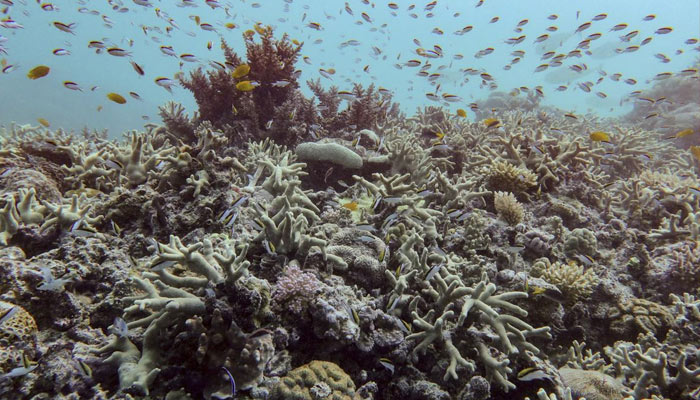
Great Barrier Reef Hit by Worst Annual Coral Loss in 40 Years Despite Previously Record Growth.
Australia’s Great Barrier Reef has suffered its most severe annual loss of live coral in over four decades, according to the Australian Institute of Marine Science (AIMS). The findings, published in AIMS’ latest annual survey, highlight the growing toll of climate change and underscore increasing volatility across the UNESCO World Heritage Site.
The report notes that in 2024, coral cover sharply declined across all three major reef regions: by nearly one-third in the south, 25% in the north, and 14% in the central region. These losses follow years of coral growth since 2017, which had pushed live coral coverage to its highest level in 39 years of monitoring.
“This has partially cushioned the blow,” said Dr. Mike Emslie, who leads AIMS’ long-term monitoring program. “But these are record declines, and repeated bleaching events are clearly beginning to overwhelm the reef’s natural resilience.”
The latest damage was primarily driven by a mass coral bleaching event — the fourth and largest ever recorded — triggered by record-breaking ocean heat in 2023 and 2024. The U.S. National Oceanic and Atmospheric Administration (NOAA) estimates that this global bleaching event, which began in January 2023 and was declared a global crisis in April 2024, has affected nearly 84% of the world’s coral reef areas across at least 83 countries.
Aerial surveys conducted by Australian authorities earlier this year found that 78 of 281 surveyed reefs in the Great Barrier Reef’s northern stretch were more than 30% bleached.
Bleaching occurs when prolonged heat stress causes corals to expel the algae that provide them with energy and color. While bleached corals are not dead, they become far more vulnerable to disease and mortality. Some reefs do recover over time, but experts warn that repeated stress weakens their long-term viability.
The report also echoes the findings of the UN’s Intergovernmental Panel on Climate Change (IPCC), which has warned that tropical coral reefs face “very high” risk even at 1.2°C of global warming. With the planet already having warmed 1.3°C since pre-industrial times, scientists caution that coral ecosystems could be virtually wiped out if warming continues at the current pace.
“Earlier projections likely underestimated the climate risks to coral reefs,” the AIMS report states. “Coral-dominated ecosystems may cease to exist at many locations if warming surpasses critical thresholds.”
With the Great Barrier Reef stretching across 344,000 square kilometers off Australia’s northeast coast, the implications of its decline are global — both ecologically and economically.
Comments are closed.