

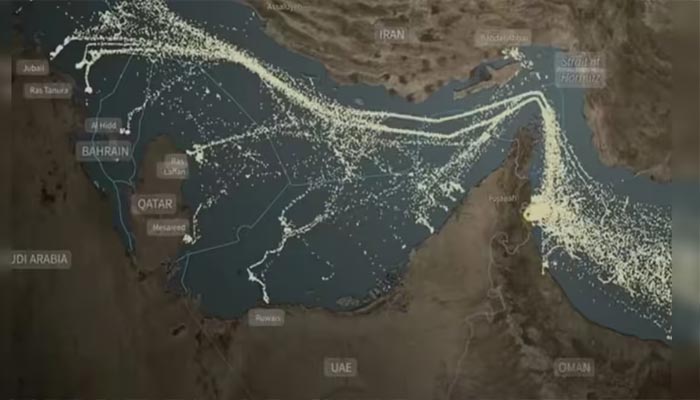
Global oil markets are facing fresh turbulence as production cuts by Gulf producers coincide with the continued disruption in the Strait of Hormuz amid the ongoing conflict involving the United States, Israel and Iran, according to a report by Bloomberg.
The Strait of Hormuz, one of the world’s most critical energy shipping routes, normally carries around a fifth of global crude oil and liquefied natural gas supplies. With tanker movement severely restricted through the narrow waterway, global energy markets have come under intense pressure, raising fears of prolonged supply disruptions.
Several Gulf producers, including the United Arab Emirates, Kuwait and Iraq, have already begun trimming oil output as storage capacity fills up and shipping risks increase. Analysts warn that more producers could follow if the disruption persists.
Saudi Arabia has attempted to mitigate the impact by redirecting part of its crude exports through pipelines to ports on the Red Sea. However, a significant portion of the region’s oil production still relies on the Strait of Hormuz, leaving global supply vulnerable.
Prices Surge Amid Supply Concerns
The supply uncertainty has triggered a sharp spike in oil prices. Brent crude jumped nearly 30% last week — its biggest weekly gain in about six years — approaching the $100-per-barrel mark.
Regional oil benchmarks have already crossed that threshold. Futures for Murban crude from Abu Dhabi settled at about $103 per barrel, while Oman crude rose to around $107. Meanwhile, Chinese crude futures traded near $109 on the Shanghai International Energy Exchange.
Stefano Grasso, senior portfolio manager at Singapore-based investment firm 8VantEdge Pte, said the longer the disruption continues, the more pressure it will place on the market. According to him, sustained supply interruptions could push prices significantly higher in the short term.
Asia Faces the Biggest Impact
The disruption is being felt most sharply in Asia, where several major economies rely heavily on Gulf oil supplies. Japan, which imports more than 90% of its crude from the Gulf region, is reportedly considering tapping into its strategic reserves.
China has already reduced fuel exports to secure domestic supply, while South Korea is reviewing possible measures to manage rising energy costs.
The effects are also spreading to Europe. In parts of northwest Europe, jet fuel prices have surged to record highs due to tighter supply and continuing disruptions in oil shipments.
Analysts at Dutch financial group ING Groep estimate that the disruption could last at least four weeks, with two weeks of complete upheaval followed by two weeks of partial flows. In a more severe scenario, a three-month shutdown of the Strait could push both crude oil and LNG prices to record levels.
Warren Patterson, head of commodities strategy at ING in Singapore, said that while the conflict may not end immediately, any weakening of Iran’s ability to threaten shipping could eventually allow oil flows through the Strait of Hormuz to gradually return to normal.
Comments are closed.