
India Ends South Korea’s 44-Year Asian Games Reign With Historic Recurve Gold

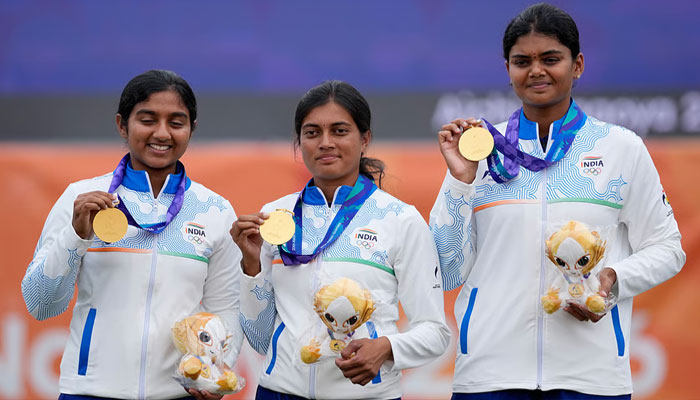
When the women’s recurve competition began at the Asian Games, few expected India’s Ankita Bhagat, Kirti Sharma and Kumkum Mohod to challenge South Korea’s long-standing dominance.
Korea arrived as the reigning world champions, with World No. 3 Kang Chaeyong leading their line-up. Recurve archery has traditionally been one of Korea’s strongest disciplines, making the prospect of an Indian upset appear daunting.
But reputation meant little to Ankita, Kirti and Kumkum.
The Indian trio produced a remarkable performance to defeat South Korea 5-3 in the final and end the country’s 44-year dominance in the women’s recurve team event. India had earlier defeated China 5-1 in the semifinals, setting up a historic showdown with the defending champions.
The achievement is even more remarkable considering the different paths the three archers have taken to reach the Asian Games podium.
Kumkum took up recurve archery only three years ago and began her journey with a traditional bamboo bow. Kirti was once told she was too thin to handle a recurve bow, which demands considerable physical strength. Ankita, meanwhile, brought experience to the team, having already won 23 international medals.
Ankita had also been part of India’s women’s recurve team that won bronze in Hangzhou. India had never previously reached the Asian Games final in the event.
That changed in Nagoya.
ANKITA, KUMKUM AND KIRTI RISE TO THE OCCASION
After their semifinal victory, the Indian trio showed remarkable composure despite challenging conditions in Nagoya. The weather affected scoring, but the three archers remained focused, constantly supporting one another.
China were the first hurdle.
The Indians produced a mixture of eights, nines and crucial 10s, with each archer stepping up when required. Kirti was particularly impressive, finding 10s with her final arrows in the opening two sets to secure valuable points for India.
In the final set, India needed to level the scores, and Kirti once again delivered under pressure to complete the 5-1 victory.
Then came South Korea.
The Korean trio of Kang Chaeyong, Lee and Yejin Oh immediately set a high standard. Yet India refused to be intimidated.
South Korea scored 54 and 56 in the opening two sets, but India matched both totals. The first two sets ended level, leaving the world champions under pressure at 2-2.
That pressure began to show in the third set. Korea hit four 8s across their six arrows, while India maintained greater consistency. The Indian trio combined for 55 to move ahead.
The fourth set produced another tense finish. Korea scored 54, meaning India needed to match that total to secure at least a tie in the set and claim the gold.
Kirti initially recorded an 8, but a review upgraded the arrow to a 9. That proved decisive as India reached 54, tying the set and sealing the historic gold medal.
For Indian archery, the victory represents a significant breakthrough in the recurve discipline. The compound archers had already enjoyed the spotlight at the previous Asian Games, but the women’s recurve team has now shown that India can challenge the world’s strongest teams in the discipline traditionally dominated by South Korea.
Ankita, Kirti and Kumkum have opened the door. The challenge now is for India’s mixed and men’s recurve teams to build on their historic achievement in Nagoya.
Comments are closed.