

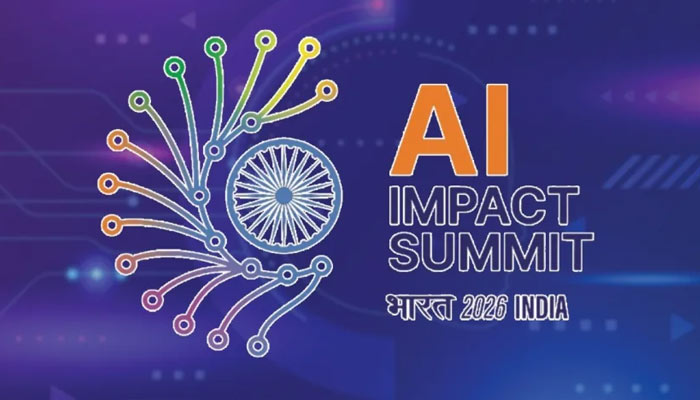
India on Monday opened one of the world’s largest artificial intelligence gatherings, with Prime Minister Narendra Modi positioning the country as a serious contender in the race to build next-generation AI systems.
The India AI Impact Summit in New Delhi is expected to bring together an unprecedented mix of global tech CEOs, founders, investors and policymakers. Among those slated to attend are Sundar Pichai of Alphabet Inc., Sam Altman of OpenAI, Dario Amodei of Anthropic and Alexandr Wang, whose firm works closely with Meta Platforms Inc.. AI researchers including Yann LeCun and Arthur Mensch are also expected to participate.
The summit’s final leg on February 19–20 will feature a keynote by Emmanuel Macron, followed by remarks from PM Modi.
India’s AI Pitch
For the government, the event is more than a showcase — it is a strategic signal. India is betting that its vast digital public infrastructure, engineering workforce and massive user base can help it leapfrog into the front ranks of AI innovation.
At the centre of that infrastructure is Aadhaar, the biometric identity platform covering more than a billion people. Combined with digital payments rails and expanding data stacks in healthcare, education and governance, policymakers argue India has the foundation to scale AI rapidly.
“By overlaying AI on our digital identity, payments and governance platforms, we can compress decades of development into years,” said Abhishek Singh, Additional Secretary at the Ministry of Electronics and IT. “What gets built for India won’t stay only in India.”
India has already exported parts of its digital stack. MOSIP, inspired by Aadhaar’s architecture, is helping countries such as the Philippines, Morocco and Uganda build national ID systems, while others are adopting similar digital payment frameworks.
Global Firms Eye India
India currently ranks third globally in AI competitiveness, behind the US and China, according to Stanford University’s Institute for Human-Centered AI.
That ranking has drawn global tech firms to the market. OpenAI and Anthropic are expanding their India presence, targeting enterprise customers and government partnerships. Google and Meta are scaling up data centre capacity to meet rising demand for AI tools like ChatGPT, Gemini and Claude.
Nvidia Corp., navigating US export restrictions in China, has also identified India as a strategic growth market, although its chief executive withdrew from the summit citing unforeseen circumstances.
Building India-Centric Models
Despite momentum, analysts caution that years of underinvestment in core research could limit India’s ability to compete at the frontier.
Aakrit Vaish, founder of AI-focused fund Activate, said India must strengthen its research ecosystem to avoid becoming merely “a testing lab for Silicon Valley’s algorithms.”
Several domestic initiatives aim to address that gap.
Government-backed BharatGen will unveil Param2, a 17-billion-parameter model supporting 22 Indian languages. Meanwhile, Sarvam AI — backed by Lightspeed Venture Partners and Khosla Ventures — is set to introduce a larger voice-first model tailored to India’s linguistic diversity.
Both projects focus on affordability and accessibility, targeting sectors such as governance, education, healthcare and agriculture.
“In India and much of the developing world, cost is not an afterthought,” said Rishi Bal, CEO of BharatGen. “Our model is designed to accelerate adoption in critical areas.”
The Road Ahead
For US firms, the rise of local, lower-cost models could complicate monetisation strategies in India, echoing challenges faced in China.
Still, some believe India’s opportunity lies beyond replicating existing large language models. Himanshu Tyagi, co-founder of Sentient AI, argues that the next frontier — advanced reasoning for science, robotics and real-world applications — may offer India a chance to close the gap.
As global AI heavyweights gather in New Delhi, the message from India is clear: it does not intend to remain a peripheral player in the AI revolution. Instead, it is positioning itself as both a vast market and an emerging architect of the technology’s future.
Comments are closed.