
“India Tells UN Security Council: Pakistan Spreading Falsehoods, Trying to Legitimize Terrorism”

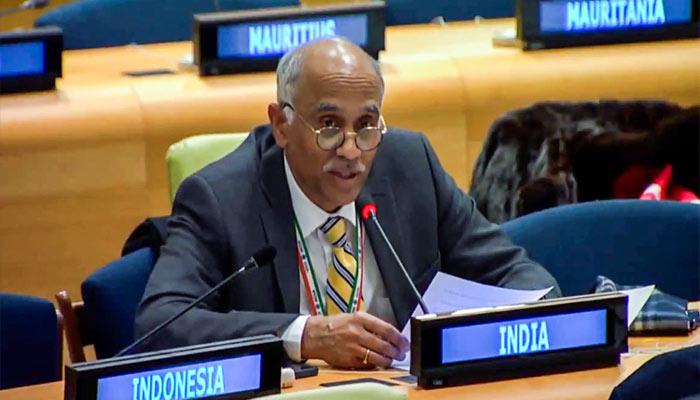
India Accuses Pakistan of Spreading Falsehoods, Using Terrorism as State Policy at UN Security Council.
India mounted a sharp and wide-ranging rebuttal against Pakistan at the United Nations Security Council (UNSC), with Permanent Representative Parvathaneni Harish accusing Islamabad of spreading falsehoods, attempting to legitimise terrorism, and repeatedly violating international commitments.
India Rejects Pakistan’s Narrative
Addressing the UNSC, Harish said he was responding to “the comments of the representative of Pakistan, an elected member of the Security Council, which has a single-point agenda to harm my country and my people.”
He dismissed Pakistan’s account of India’s military actions last year as “false and self-serving,” particularly regarding the April 2025 attack in Jammu and Kashmir’s Pahalgam, where Pakistan-sponsored terrorists killed 26 civilians.
“This August body itself called for holding the perpetrators, organisers, financiers, and sponsors accountable. That is exactly what India did,” Harish stated, stressing that India’s response was measured, non-escalatory, and focused on dismantling terrorist infrastructure.
He added that Pakistan had continued issuing threats until May 9, after which its military directly contacted India to request a cessation of hostilities.
Highlighting Damage to Pakistani Facilities
Harish underscored the impact of Indian operations, noting that “the destruction caused to multiple Pakistani air bases, including runways and burnt-out hangars, is in the public domain.”
He rejected Pakistan’s rhetoric about a “new normal,” saying:
“Terrorism can never be normalised as Pakistan wishes to do. It is not normal to tolerate Pakistan’s continued use of terrorism as an instrument of state policy. This hallowed chamber cannot become a forum for Pakistan to legitimise terrorism.”
On Kashmir and the Indus Waters Treaty
Harish reaffirmed India’s stance on Jammu and Kashmir:
“Pakistan has no locus standi to comment on matters internal to India. The Union Territory of Jammu and Kashmir has been, is, and will always remain an integral and inalienable part of India.”
On the Indus Waters Treaty, he said India had signed it in good faith 65 years ago, but accused Pakistan of repeatedly violating its spirit through conflicts and terror attacks. Consequently, India placed the treaty in abeyance until Pakistan ends its support for cross-border terrorism.
Call for International Accountability
The Indian envoy also urged Pakistan to introspect on its governance and rule of law, pointing to constitutional provisions that grant the military extraordinary powers and immunity.
Harish concluded by stressing the need for stronger international legal mechanisms and reforms in multilateral institutions, calling them a “strategic necessity” for the UN to maintain global peace and security.
Comments are closed.