

“We Saw Blasts, Dead Bodies”: Evacuated Indian Students Return From Iran Amid Growing Uncertainty.
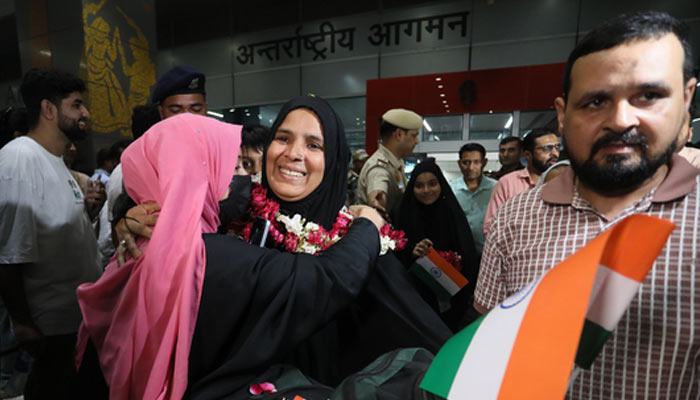
Clutching the Indian flag in one hand and fighting back tears, Mizban stepped out of Delhi’s Indira Gandhi International Airport on Saturday evening, visibly shaken. “We saw dead bodies. Heard blasts. Saw airstrikes,” she said quietly, eyes darting across the unfamiliar calm. “From Tehran to Qom to Mashhad, we kept moving. I’m just grateful to be home.”
Mizban is one of 256 Indian students, many from Jammu and Kashmir, who returned home from Iran aboard a special evacuation flight, part of Operation Sindhu — India’s mission to bring citizens back from conflict zones after hostilities between Iran and Israel escalated sharply on June 13.
Near the arrival gate, Zubeda, a mother from Srinagar, clutched a worn photograph of her son, a medical student in Tehran. “He barely called during the crisis, just once or twice. He hid his fear to protect me,” she said. “I want him to become a doctor — just not at the cost of surviving a war.”
Operation Sindhu: Risky Roads, Rare Exceptions
So far, three chartered flights — two from Iran’s Mashhad and one from Turkmenistan’s Ashgabat — have brought back over 827 Indian nationals, with a fourth flight expected to push the total past 1,000. The latest arrivals on flight IRM071A include medical and seminary students who had been stranded across Iranian cities as missile exchanges intensified in the region.
“Tehran changed overnight,” said Ahabashi, a final-year student. “We lived with the fear that death could come at any moment — and far from home. But every detail of our evacuation was handled with care. The Indian government stood by us.”
Students were first moved from Tehran to Qom, then onward to Mashhad — a risky journey through volatile zones. Despite its closed airspace, Iran made rare exceptions to facilitate India’s emergency extractions. Mohammad Javad Hosseini, India’s Deputy Chief of Mission in Tehran, acknowledged Iran’s cooperation as “a gesture of goodwill.”
Trauma at Home, Futures in Limbo
As sirens blared and airstrikes lit up the night skies of Tehran, Sumarah Rahman, a young medical student from Kashmir, said survival was their only focus. “We were terrified. Nights were filled with sirens and explosions. But now we’re home. God willing, we’ll return only when it’s safe.”
Junaid, whose younger siblings were among the evacuees, recalled a communications blackout. “My sister called us from unknown numbers when she could. Their university was close to bombing zones. My brother got out first — we were terrified for her,” he said.
The Jammu and Kashmir Students’ Association thanked the Indian government and Iranian authorities for coordinating the safe return. “We remain committed to ensuring the evacuation of every remaining student, especially those from remote areas,” the group said in a statement.
Despite the relief, a sense of uncertainty looms. Many students had chosen Iran for its affordable medical education, a chance they couldn’t find within India’s competitive academic system. That path is now blurred.
“I want my son to follow his dream,” said Zubeda softly, “but I never want to feel this fear again.”
Comments are closed.