
IPL Play of the Day: RCB’s triple-strike in death overs stifles GT in final stretch

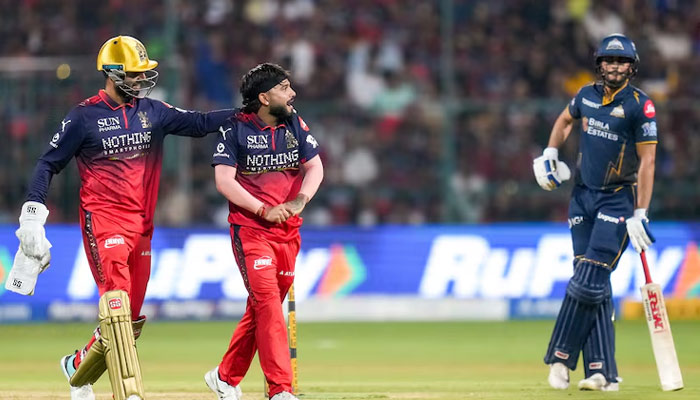
With four overs remaining in Gujarat Titans’ innings at the M Chinnaswamy Stadium on Friday, April 25, the game was firmly in their control.
Gujarat Titans had momentum on their side, with Jos Buttler well set and Royal Challengers Bengaluru staring at the possibility of a massive finish. But what followed over the next 18 deliveries completely changed the tone of the innings.
At that stage, Buttler was beginning to accelerate and Washington Sundar had settled in quickly, with the scoring rate already crossing 10 runs per over. A total well above 170 looked likely, even a push towards 190 if the finishing overs clicked. Instead, RCB produced a disciplined late-innings squeeze that completely stalled the charge.
Across the 17th, 18th and 19th overs, GT managed just 17 runs, with no boundaries in two of them and a crucial wicket falling in the middle phase. The shift wasn’t sudden—it was built through smart captaincy and execution under pressure.
The turnaround began with RCB captain Rajat Patidar’s bold decision to bring back Suyash Sharma despite an expensive previous over. At a critical juncture, with batters still settling into their roles, the move paid off as Suyash bowled a tight over, giving away just four runs and refusing GT any early release.
That quiet over created pressure rather than visible damage. With overs running out, the batting side was forced to accelerate sooner than planned.
Sensing the moment, RCB turned to Bhuvneshwar Kumar, who struck at the right time by removing Buttler. That wicket proved decisive, breaking the set batter’s control and forcing GT into a rebuild mode at the worst possible stage of the innings.
From there, the momentum never recovered. Sundar and debutant Jason Holder were kept in check, managing just five runs in the following over as RCB’s bowling discipline tightened further.
The final decisive move came when Patidar introduced Josh Hazlewood in the 19th over instead of saving him for the last. The strategy ensured there was no weak over left for GT to target late in the innings. Hazlewood responded with tight lines and control, denying boundaries and sealing the chokehold that had been building over the previous overs.
By the end of the 19th, GT’s innings had lost its late surge entirely. What once looked like a 180-plus total had been pulled back significantly, thanks to three overs of sustained pressure rather than one standout moment.
RCB’s finish was a reminder that in T20 cricket, games are often decided not just by big hits, but by small, controlled phases where pressure quietly builds—and eventually breaks the innings apart.
Comments are closed.