

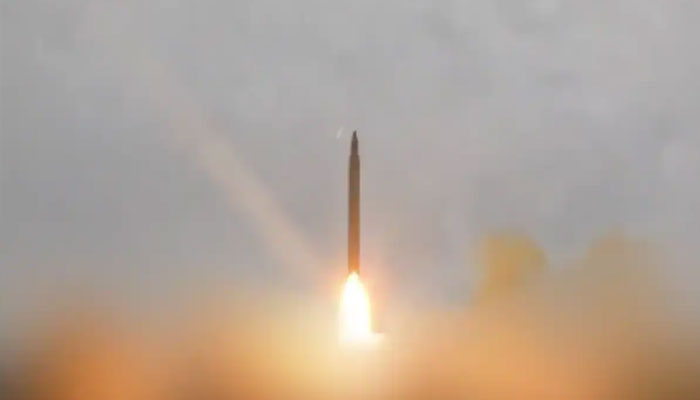
Iran’s reported launch of two intermediate-range ballistic missiles towards a US-UK base in Diego Garcia marks a sharp escalation, shifting attention to range, signalling and strategic geography.
While one missile reportedly failed and the other may have been intercepted, the attempt itself is significant enough to redraw the regional risk calculus.
Located nearly 4,000 km from Iran, Diego Garcia sits far beyond Tehran’s publicly stated missile range limit of 2,000 km. If the strike attempt indeed targeted that distance, it raises serious questions about the true extent of Iran’s undeclared capabilities.
Analysts suggest Iran may be testing systems closer to full-fledged intermediate-range ballistic missiles (IRBMs), potentially extending its reach deeper into the Indian Ocean and parts of southern Europe. This ambiguity over actual range enhances Tehran’s strategic leverage by keeping adversaries uncertain about its strike envelope, complicating defence planning for the United States and the United Kingdom.
Any indication of extended missile capability is also likely to pressure Gulf states and Israel to reassess their missile defence architecture.
Diego Garcia is not just a remote outpost but a critical hub for US power projection, hosting long-range bombers and surveillance assets. Targeting such a high-value node signals an expansion of the conflict theatre from the Middle East into the Indian Ocean region.
Iran’s semi-official Mehr News Agency described the move as a “significant step,” suggesting that the perceived range of its missile arsenal may exceed what adversaries had previously assumed.
By attempting to strike Diego Garcia, Tehran has sent a broader message: that even distant US assets may not be beyond reach. This could force Washington and London to redistribute missile-defence resources further south, stretching their existing deployments.
The technical outcome—whether the missiles hit, failed, or were intercepted—may ultimately be less consequential than the strategic signalling. Reports indicate the US may have deployed an SM-3 interceptor; even so, compelling the use of such high-end defence systems carries its own strategic cost. If the interception was unsuccessful, it would further underscore how even limited or older missile platforms can strain advanced missile-defence networks.
Comments are closed.