
JD Vance Calls H-1B Workers ‘Indentured Servants’, Accuses Tech Giants of Visa Abuse

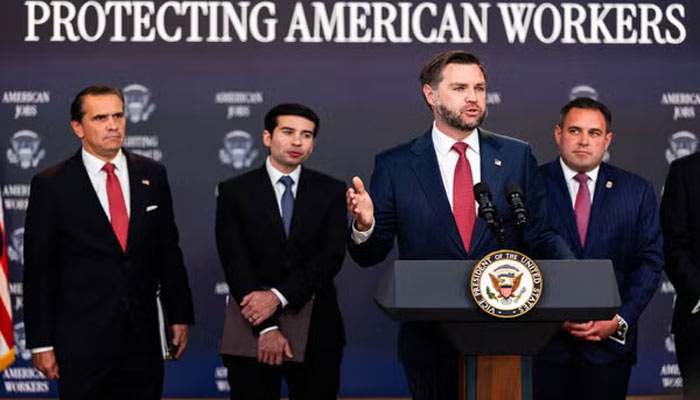
JD Vance Accuses Microsoft, Tech Giants of H-1B Visa Abuse; Calls Foreign Workers ‘Indentured Servants’
US Vice President JD Vance has accused Microsoft and other major technology companies of misusing the H-1B visa programme to hire foreign workers at lower wages while laying off American employees. Describing some foreign workers brought in through outsourcing firms as “indentured servants”, Vance alleged that companies were exploiting the immigration system to reduce labour costs and increase profits.
The controversy comes as the Trump administration intensifies its scrutiny of employment-based immigration programmes. Microsoft has reportedly been suspended from a programme that enables employers to sponsor foreign workers for permanent residency amid allegations of fraud and misuse.
“If you are working as an H-1B visa in the United States of America, you’re earning $20,000 less than an American citizen hired in the same position. If you were brought in by one of these foreign outsourcing firms, you’re making $48,000 less than an American citizen in a similar position,” Vance said.
He alleged that some companies were taking advantage of wage differences by recruiting foreign employees while reducing their American workforce.
“You bring in indentured servants from outside the country, you lay off American workers and, if you’re a corporation, you make a ton of money by undercutting the wages of American workers, replacing them with people who frankly shouldn’t be in the United States of America to begin with,” the Vice President said.
Vance Questions Microsoft’s Hiring and Layoff Figures
Vance singled out Microsoft, alleging that the company had been among the biggest abusers of the H-1B visa system. He cited the company’s workforce reductions in 2025, claiming that Microsoft laid off 6,000 American employees after certifying that it could not find suitably qualified US workers for certain positions.
According to figures cited by Vance, Microsoft also secured approvals for more than 6,000 H-1B visas and filed 3,682 applications for permanent labour certification, commonly known as PERM.
Nearly 1,000 of those applications reportedly involved positions corresponding to jobs held by American employees who had been laid off.
The allegations have intensified scrutiny of hiring practices at technology companies that depend on skilled foreign professionals. Vance argued that the H-1B programme, designed to help US employers recruit specialised talent, was being used in ways that could disadvantage American workers.
The claims have added to the wider debate over whether companies are using employment-based immigration to address genuine skill shortages or to reduce labour expenses. The allegations do not, by themselves, establish that every affected visa application or hiring decision involved wrongdoing.
Microsoft Not the Only Company Facing Scrutiny
US Labour Secretary Keith Sonderling said several other major technology companies had also faced suspensions from the programme. The companies named included Cognizant, Infosys, Tata, Wipro, HCO, Capgemini and Adobe.
The administration also announced investigations into nine universities, including Harvard, Yale and Stanford, over allegations that international student hiring practices were being used to undercut American wages.
Labour Department Inspector General Anthony D’Esposito said subpoenas had already been served as part of the investigations.
The measures form part of the Trump administration’s broader effort to examine whether employers and educational institutions are complying with the rules governing foreign-worker recruitment and immigration programmes.
The developments could have implications for technology companies and outsourcing firms that rely on international talent, including Indian IT service providers with substantial operations in the United States.
How H-1B Visa Holders Can Obtain Green Cards
The H-1B visa permits eligible foreign professionals to work temporarily in the United States, while a green card provides permanent resident status. An H-1B visa does not automatically lead to permanent residency, although many workers pursue employment-based green cards through their employers.
For many employment-based immigration cases, the process begins with PERM labour certification. The employer must generally demonstrate that there are insufficient qualified, willing and available US workers for the position and that employing a foreign worker will not adversely affect the wages and working conditions of similarly employed American workers.
Once the Department of Labour approves the PERM application, the employer can generally file an I-140 immigrant petition with US Citizenship and Immigration Services.
The worker may subsequently apply for permanent residency when an immigrant visa becomes available, subject to the applicable category, priority date and other eligibility requirements.
The latest controversy highlights the distinction between temporary employment visas and permanent immigration pathways. It also raises questions about how the US government should balance employers’ demand for specialised international talent with safeguards intended to protect domestic workers.
As investigations and enforcement measures continue, technology companies, outsourcing firms and foreign professionals are likely to face increased scrutiny over recruitment practices, wage compliance and employment-based immigration applications.
Comments are closed.