
Lionel Messi and Argentina: The Journey That Redefined International Football

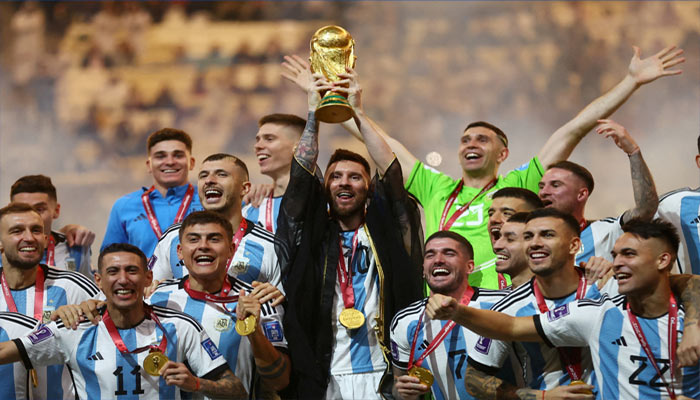
Few sporting relationships have carried the weight, emotion and drama of Lionel Messi’s journey with Argentina.
Cricket has Sachin Tendulkar and India. Basketball has Kobe Bryant and the Los Angeles Lakers. Formula One has Michael Schumacher and Ferrari. In football, the story of Messi and Argentina belongs in that same category — a relationship shaped by immense expectations, painful defeats, unforgettable triumphs and, ultimately, an unbreakable bond.
For much of his career, Messi was identified with Barcelona. The club became synonymous with his brilliance and success. Yet behind the blue and red of Barcelona was another identity that Messi never allowed to fade: Argentina.
Now, that chapter has reached its conclusion. At 39, Messi has announced his retirement from international football, confirming that he will not wear Argentina’s iconic colours again.
It is an ending that feels almost cinematic — filled with heartbreak, redemption, glory and a lifetime of devotion to the Albiceleste.
‘I NEVER STOPPED BEING ARGENTINE’
Messi’s connection with Argentina began long before he became one of the greatest players in football history.
As a youngster developing his career in Spain, there was a point when questions emerged over which country he would ultimately represent. Spain were interested in securing the services of the prodigious talent, but Argentina’s pull proved stronger.
Messi never appeared willing to turn his back on the country where he was born.
“I’ve never stopped being Argentine, and I’ve never wanted to,” he once said. “I feel very proud of being Argentine, even though I left there.”
His performances for Argentina’s youth teams reinforced that connection. At the 2005 FIFA U-20 World Cup in the Netherlands, Messi scored six goals, including both goals in the final against Nigeria. He collected both the Golden Boot and Golden Ball as Argentina lifted the trophy.
His senior debut, however, could hardly have been more chaotic.
Against Hungary in August 2005, Messi was sent off just 47 seconds after coming onto the field.
It was an inauspicious beginning to what would become one of international football’s greatest careers.
Soon enough, though, the goals arrived. In his sixth start for Argentina, Messi scored his first senior international goal, curling the ball into the net after cutting in from the left — a move that would become one of the signatures of his career.
The 2006 World Cup in Germany offered the teenager his first taste of football’s biggest stage. Messi scored against Serbia and Montenegro and announced himself to the world, even though Argentina’s campaign ended in the quarter-finals.
Two years later, he helped Argentina win Olympic gold in Beijing.
By then, the expectations were enormous. Argentina gave Messi the No. 10 shirt, previously worn by Diego Maradona, effectively making him the heir to one of the country’s greatest sporting icons.
Maradona himself played a role in the transition.
“I remember Diego telling me he wanted to give me the shirt he’d worn, that he saw me ready to wear it, and that it was time,” Messi recalled.
WHEN LOVE BROUGHT HEARTBREAK
But the relationship between Messi and Argentina was never going to be defined by victories alone.
The first major heartbreak came at the 2007 Copa America, when Argentina lost the final to Brazil. More disappointment followed, culminating in the 2014 World Cup.
Argentina reached the final in Brazil, with Messi carrying much of the team’s hopes. Germany eventually won 1-0 in extra time, leaving Messi with the Golden Ball but without the trophy he wanted most.
The contrast with his club career was striking. At Barcelona, trophies and individual awards arrived almost relentlessly. With Argentina, glory remained frustratingly out of reach.
The 2015 Copa America brought another opportunity. Argentina reached the final but lost to Chile on penalties.
A year later, the Copa America Centenario offered Messi another chance. He became Argentina’s all-time leading scorer during the tournament, yet the final again ended in defeat to Chile on penalties.
The disappointment became too much.
“I’ve done all I can. It hurts not to be a champion,” Messi said after the 2016 final.
He announced his retirement from international football.
But true love rarely ends that easily.
Just weeks later, Messi returned to the Argentina fold.
THE REDEMPTION
The turning point arrived under Lionel Scaloni.
Argentina began building a team around Messi — not simply expecting him to rescue them, but surrounding him with players prepared to fight alongside him.
The transformation was dramatic.
At the 2021 Copa America in Brazil, Messi scored four goals and provided five assists. Argentina defeated Brazil in the final, with Angel Di Maria scoring the decisive goal.
After years of disappointment, Messi finally had his first major international trophy with Argentina.
The 2022 Finalissima victory over Italy added another piece of silverware.
Then came Qatar.
Argentina’s World Cup campaign began with a shock 2-1 defeat to Saudi Arabia. Once again, the pressure was on Messi.
But he responded.
He scored against Mexico, found the net against Australia and produced decisive moments against the Netherlands and Croatia. Argentina reached the World Cup final, where France stood between Messi and the one trophy that had always eluded him.
What followed became one of the greatest World Cup finals ever played.
Messi scored twice as Argentina and France drew 3-3 after extra time. He then converted his penalty in the shootout as Argentina finally lifted the World Cup.
Messi had conquered the final mountain.
Two years later, Argentina won another Copa America, further cementing one of the greatest international eras in the country’s history.
THE FINAL CHAPTER
By the time the 2026 World Cup arrived, Messi had already achieved almost everything possible in football.
There was still, however, one final journey to make.
The campaign brought its own emotional challenges. Away from football, Messi faced the devastating loss of his father, Jorge. Yet on the pitch, he continued to lead Argentina.
A hat-trick against Algeria provided an early highlight, while difficult matches against Cabo Verde and Egypt demanded resilience. Messi remained central to Argentina’s progress and produced two assists in the semi-final victory over England.
But the final brought disappointment.
For Messi, the defeat marked the end of a journey that had lasted more than two decades.
After his father’s death, his relationship with football had changed. The desire and emotional connection that had driven him for so long were no longer the same.
Eventually came the decision to say goodbye.
“It was a decision that hurt, and still hurts deeply, but I understand that this is the right time,” Messi said.
He insisted that he had always given everything for the Argentina shirt — through the years of disappointment as well as the period of unprecedented success.
“I love, have loved and will always love being part of the national team,” he said. “I gave everything I had; I have nothing more left to give.”
Those words perhaps explain Messi’s relationship with Argentina better than any trophy ever could.
He could have walked away after the heartbreak of 2016. He could have chosen a different international path when he was a teenager in Spain. He could have allowed years of criticism to break his connection with the national team.
He did none of those things.
Instead, he kept returning.
He endured the defeats, carried the expectations, accepted the criticism and eventually delivered the trophies Argentina had been waiting for.
Messi’s story with Argentina was never simply about football. It was about belonging.
And perhaps the most fitting words came from Messi himself:
“Thank you, God, for making me Argentine. Vamos, Argentina!”
A love story that began with uncertainty, survived years of heartbreak and reached its greatest heights has finally come to an end.
But for Argentina and Lionel Messi, the memories will remain forever.
Comments are closed.