

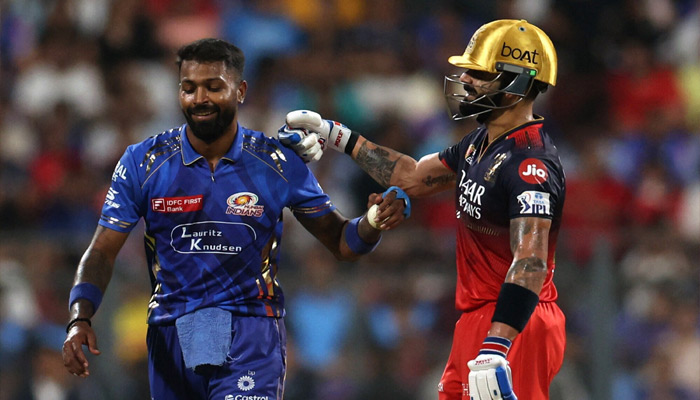
For 18 years, Virat Kohli has been the engine driving Royal Challengers Bengaluru. But on Sunday at the Wankhede Stadium, the machine roared ahead without its most trusted component.
On a batting paradise against the Mumbai Indians, Kohli’s 38-ball fifty felt oddly detached from the carnage unfolding around him. In an innings defined by brute force and relentless acceleration, he appeared like a sputtering auto-rickshaw stranded on a Ferrari highway—watching a revolution speed past from behind the wheel.
Sent in on a dewy evening, RCB knew 200 was merely the entry ticket. Against Mumbai’s intimidating batting line-up, anything less would have been inadequate. The Impact Player rule has transformed T20 batting into an arms race—totals once considered monumental are now chased down with unsettling ease. The pressure, therefore, wasn’t just present; it was suffocating.
At times, Kohli seemed to be playing in a different era—one where a run-a-ball consolidation phase still held value, where a strike rate of 130 didn’t invite scrutiny. But in this hyper-accelerated version of T20 cricket, every dot ball is a liability, every quiet over a missed opportunity for the next hitter waiting in the wings.
Kohli took 38 balls to reach his fifty.
And yet, RCB still soared to 240.
Phil Salt led the charge with a blistering 78 off 36 balls, dismantling the attack with six towering sixes. Captain Rajat Patidar turned batting into a spectacle, hammering 53 off just 20 deliveries at a staggering strike rate of 265. Tim David added the finishing touches with a 16-ball 34. In that context, Kohli’s innings stood out—not for dominance, but for its dissonance.
On such a surface, a sub-150 strike-rate fifty while setting a target often becomes the difference between winning and losing. This time, Kohli was spared. Salt compensated emphatically, and Patidar ensured Mumbai’s bowlers remained under siege.
The burden of the Impact Player
Now mentoring Lucknow Super Giants, Kane Williamson summed up the modern batter’s dilemma.
With teams effectively batting till No. 8 or 9, the traditional pacing of an innings has given way to constant maximisation. There is little room for phases anymore—only pressure to deliver instantly.
While Williamson was referring to Rishabh Pant, the observation fits the broader landscape. And Kohli, more than most, has adapted to this shift with remarkable success.
Has Kohli kept pace?
Since the Impact Player rule’s introduction in 2023, Kohli’s Powerplay strike rate has jumped to 153 across 48 innings, a sharp rise from sub-120 figures earlier. When setting targets, he has scored 13 fifties in this period—six of them at strike rates exceeding 150.
By those standards, Sunday was an anomaly.
Kohli knew it too. There was no celebration upon reaching his half-century in the 15th over. At the other end, Patidar was already blazing away at 46 off 13. Two balls later, Kohli miscued a full toss from Hardik Pandya and departed—his frustration unmistakable as he flung his helmet and gloves after walking off.
Ironically, the innings had begun with promise. He flicked Trent Boult for a six that defied angles and physics, raced to 22 off 14 in the Powerplay, and looked set. But the familiar slowdown crept in post-Powerplay. Against Mitchell Santner, he managed just two runs in a crucial over—an early sign of the rhythm slipping away.
Meanwhile, Salt and Patidar operated in a different dimension altogether, dismantling anything remotely hittable.
The unthinkable: retire him out?
As Kohli edged towards his fifty, even the unthinkable entered the discourse—should he be retired out?
The sight of Tim David padded up near the boundary was telling. It hinted at urgency, at a tactical shift dictated by the format’s evolution. Commentators didn’t hold back. Dale Steyn noted Kohli would have wanted to be further ahead, while Sunil Gavaskar pointed to his limited strike in the Powerplay.
It was, ultimately, a rare off-key performance from a master of the format. But it also reflected a larger truth: T20 cricket is evolving faster than ever, and even the greats are not immune to its demands.
Anchors, once essential, are increasingly becoming obsolete in a format driven by relentless aggression.
Kohli no longer plays T20 internationals, but for RCB, the expectations remain unchanged—and so does his awareness of the need to evolve.
This was an aberration, not a pattern.
And if history is any guide, a quiet night for Virat Kohli is often followed by a statement loud enough to silence any doubt.
Comments are closed.