
‘No Power, No Water, No Relief’: Gurugram, Faridabad Residents Hit Hard by Ongoing Haryana Strike

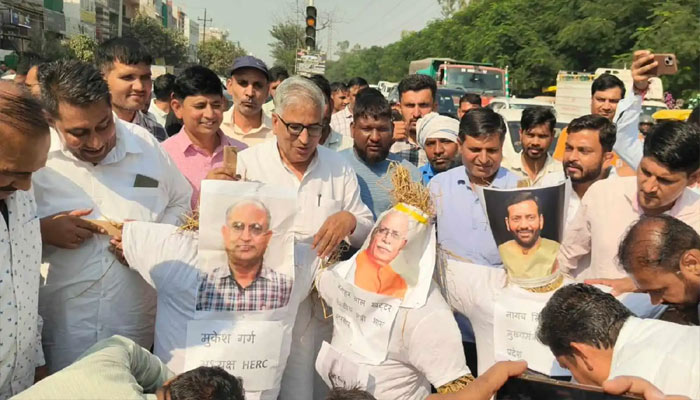
Haryana Power Strike: Gurugram, Faridabad Reel Under Outages as Residents Battle Water Shortages and Internet Disruptions
A three-day strike by nearly 40,000 electricity employees and engineers in Haryana has disrupted power supply across several areas, leaving residents struggling with exhausted inverters, dry taps and interrupted internet services. Gurugram, Faridabad and Nuh are among the worst-affected districts, with homes, offices, shops and industrial units reporting outages since 10 pm on Wednesday, October 21.
The strike began on October 22 and is scheduled to continue until October 24. Electricity employees are protesting against the Haryana Electricity Regulatory Commission’s (HERC) decision to grant a 25-year parallel electricity distribution licence to private company Eleven Power Private Limited for Gurugram and Nuh.
According to an official quoted by PTI, Gurugram received more than 3,000 electricity-related complaints within the first 12 hours of the disruption. The prolonged outages have affected household water supplies, work-from-home arrangements, students’ studies and industrial production, prompting calls for urgent intervention by the state government.
WHY ARE HARYANA’S ELECTRICITY EMPLOYEES ON STRIKE?
The immediate cause of the agitation is HERC’s October 19 order granting Eleven Power Private Limited a 25-year parallel electricity distribution licence for Gurugram and Nuh under Section 14 of the Electricity Act, 2003.
Haryana’s electricity distribution network has traditionally been managed by two state-owned utilities: Uttar Haryana Bijli Vitran Nigam (UHBVN) and Dakshin Haryana Bijli Vitran Nigam (DHBVN). The new licence would allow Eleven Power to become the first private company to enter the state’s electricity distribution sector.
A parallel licence permits another distributor to operate within the same geographical area. The arrangement could give more than 8.3 lakh electricity consumers in Gurugram and Nuh—including households, farmers, shops and industrial establishments—the option of choosing between two distribution companies.
However, electricity employees and engineers oppose the move, arguing that private participation in commercially important areas could amount to indirect privatisation and weaken the state-owned distribution system.
The Haryana Electricity Employees and Engineers Joint Struggle Front has demanded the cancellation of the licence and the introduction of a clear policy against parallel licensing. Union representatives have warned that allowing a private operator into high-revenue areas could undermine DHBVN’s financial position and threaten employees’ job security and service conditions.
The unions maintain that the dispute extends beyond employment issues, raising broader questions about public electricity distribution, farmers’ interests and consumer welfare.
GURUGRAM RESIDENTS FACE POWER CUTS, DRY TAPS AND NO WI-FI
Gurugram has experienced widespread disruption as prolonged power cuts exhausted backup systems in several residential neighbourhoods. With electricity unavailable, residents have also faced interruptions to water supply and internet connectivity.
A Sector 7 resident told The Indian Express that the power went out at around 10 pm on Wednesday. By Thursday morning, his inverter had run out of charge, the water supply had stopped and the Wi-Fi connection was no longer functioning.
The outage disrupted his work-from-home routine, while his children, who were preparing for engineering entrance examinations and government competitive tests, struggled to study.
The resident also said his attempts to register a complaint through electricity helpline 1912 were unsuccessful. He alleged that officials could not be reached by phone and that there was no clear information about when electricity would be restored.
Similar problems were reported in Sector 5, where residents said electricity-dependent water distribution systems had stopped functioning. TR Adalkha, president of the Sector 5 Residents’ Welfare Association, said the outage had prevented some people from reaching their offices and others from working remotely. Children were also affected by the lack of water at home.
Power cuts were reported in Sectors 5, 7, 10A and 52, as well as Palam Vihar and Daulatabad. DLF Phase 2 also experienced an outage, although residents said supply had returned there by noon on Thursday. Electricity was restored in Sector 7 around 4 pm, while the disruption in Sector 5 was continuing when The Indian Express published its report.
Housing societies along the Dwarka Expressway began stocking diesel for generators in anticipation of prolonged outages. Sunil Sareen, deputy convenor of the Dwarka Expressway Gurugram Development Association, said societies had made arrangements to manage possible power disruptions.
FARIDABAD RESIDENTS TAKE TO THE STREETS OVER OUTAGES
Faridabad has also reported significant disruption, with residents in Sectors 16 and 31 complaining about prolonged electricity cuts. Some said the supply had been unavailable since midnight, while others reported outages beginning early Friday morning.
Frustrated residents took to the streets to demand the immediate restoration of electricity.
In New Industrial Township-2, residents protested after an extended outage disrupted household electricity and water supplies. Reports said people blocked a road after going without electricity for around 13 hours, prompting police intervention.
Gurugram also witnessed a road blockade at the Daulatabad flyover on Thursday evening, as residents protested against outages affecting several parts of the city. The demonstration added to traffic disruption while residents demanded action from the authorities.
In Nuh, power supply problems were reported in areas including Punhana, Nagina and Firozpur Jhirka.
The disruption across the three districts has turned the employees’ protest into a wider public-service crisis, affecting residents and businesses far beyond the immediate dispute over the private distribution licence.
GURUGRAM INDUSTRIES WORRY ABOUT PRODUCTION LOSSES
The power cuts have also disrupted commercial and industrial operations in Gurugram, particularly in Sector 37, Kadipur and Basai. Businesses that rely on uninterrupted electricity have reported halted machinery and interrupted production.
Deepak Maini, chairman of the Progressive Federation of Trade and Industry, said electricity supply in Gurugram’s Sector 37 had been unavailable since 10 pm on Wednesday. He warned that prolonged outages could affect manufacturing, the availability of finished products and the timely delivery of goods.
Industrialists have expressed concern that financial losses could run into crores of rupees if disruptions continue across hundreds of units.
Beyond the immediate inconvenience, the strike threatens production schedules, commercial commitments and supply chains. Businesses dependent on functioning machinery and reliable electricity face increasing pressure the longer the disruption continues.
SOCIAL MEDIA OUTRAGE: ‘NO FANS, NO LIGHTS, NO LIFE’
Public frustration has also surfaced on social media, where residents have shared accounts of their difficulties during the outages.
One user claimed that large parts of Haryana were experiencing darkness, alleging that some cities, including Faridabad, Jhajjar, Jind and Sonipat, had faced load shedding lasting more than 48 hours.
Another user describing the situation in Faridabad said their household had been without electricity since the previous night. With the inverter exhausted, Wi-Fi unavailable and mobile phone batteries running low, the user questioned how people were expected to work, study and manage routine activities.
A separate post described the situation as a “complete blackout”, highlighting the difficulty of living without fans and lights. Other users criticised the disruption and called for action against the striking employees.
These posts illustrate the anger among some residents, but individual accounts and claims about outages lasting more than 48 hours should not be treated as verified figures for the entire state.
For affected households, the immediate concern remains the loss of essential services, including electricity, water and internet access, because of a dispute involving the government, the regulator and employee unions.
EMPLOYEES DENY DELIBERATELY DISRUPTING POWER SUPPLY
Electricity employee representatives have defended the agitation, saying their protest is aimed at a policy decision that could alter the future of public electricity distribution in Haryana.
The Electricity Employees Federation of India (EEFI) claimed that 96% of power employees in Gurugram had participated in the strike. The figure was cited in a report by The Indian Express and represents the federation’s account of participation.
EEFI national vice-president Subhash Lamba said employees regretted the inconvenience faced by residents but maintained that workers had not deliberately switched off the electricity supply. He said staff members were unavailable to respond to breakdowns and repair faults during the agitation.
Lamba also said employees would continue reporting for duty at hospitals and other essential establishments.
The unions insist that the government must address the decision to grant the private licence and its potential consequences for workers, consumers and the state-owned distribution utility. They have maintained that withdrawing the licence is necessary to resolve the dispute.
However, their position has done little to ease the difficulties of residents who depend on electricity department personnel to respond to faults and restore supply.
HARYANA GOVERNMENT TO CHALLENGE HERC DECISION
The Haryana government has said it opposes the introduction of private electricity distribution through the licence and intends to challenge HERC’s order before the Appellate Tribunal for Electricity (APTEL).
Chief Minister Nayab Singh Saini said the state would strongly present the employees’ concerns during the legal proceedings. He also offered to involve lawyers selected by the unions in the effort to challenge the order.
Saini chaired a review meeting with administrative secretaries to assess preparations for the strike and appealed to employees to call off their agitation. He directed deputy commissioners to establish district-level monitoring committees that would report to a high-level committee led by the Chief Secretary.
The government said the committees would monitor the situation, coordinate the response and help ensure that essential services remained operational.
Energy Minister Anil Vij said the government would approach APTEL within five to six days and seek an immediate stay on the licence. He added that the state was prepared to approach the Supreme Court if the tribunal did not provide relief.
Vij also said HERC is an autonomous regulator established under the central Electricity Act and that the licence had been granted despite the state government’s opposition to privatisation. He urged employees to participate in the legal challenge instead of continuing the strike.
The government wants the dispute to be resolved through legal proceedings while electricity services continue. The unions, however, have insisted that the licence itself must be withdrawn.
HELPLINES ISSUED AS ADMINISTRATION PRIORITISES ESSENTIAL SERVICES
Gurugram Deputy Commissioner Uttam Singh held discussions with electricity department officials and union representatives in an effort to resolve the dispute. Talks continued late into Wednesday night but failed to produce an agreement to end the strike.
The district administration instructed officials to prioritise electricity supply to hospitals, drinking water pumping stations, Metro rail networks and other essential facilities. Officials were also directed to remain alert and attend to local faults wherever possible.
The administration issued the following contact details for electricity-related complaints:
DHBVN toll-free helpline: 1912
Additional helpline: 180010804334
WhatsApp complaint number: 8813999708
Additional WhatsApp number: 9540954768
Residents experiencing outages can use these channels to report faults, although some consumers have complained that their calls were unanswered or disconnected during the disruption.
WHAT DOES THE ELEVEN POWER LICENCE MEAN FOR CONSUMERS?
The proposed entry of Eleven Power has sparked a wider debate about the future of electricity distribution in Haryana.
Employee unions fear that allowing a private company to operate alongside DHBVN in Gurugram and Nuh could weaken the public utility, threaten jobs and eventually lead to wider privatisation. They have also raised concerns about the potential impact on farmers and ordinary consumers.
The state government has said it will oppose the decision through legal channels. HERC has granted the licence, and the outcome of the government’s appeal could determine whether its implementation is delayed or modified.
Some residents and business owners, meanwhile, have suggested that a private distributor could improve service quality and reduce outages if it delivers more reliable electricity.
The central question is whether competition between distributors would improve consumer services or weaken the existing public distribution system and its workforce. The licence alone does not establish which outcome will occur; the actual impact will depend on implementation, regulatory oversight and service performance.
STRIKE CONTINUES AS RESIDENTS WAIT FOR POWER TO RETURN
With the three-day strike scheduled to continue until October 24, residents in affected parts of Haryana remain concerned about the restoration of electricity, water and internet services. Industrial and commercial establishments are also facing pressure to resume normal operations.
As the government prepares to challenge HERC’s decision and unions maintain their opposition to the licence, consumers continue to bear the immediate cost of the standoff. A resolution will be crucial to restoring essential services and addressing the broader dispute over the future of Haryana’s electricity distribution network.
Comments are closed.