
‘PM Can Be Trusted’: Centre Defends Exclusion of CJI From CEC Selection Panel in SC

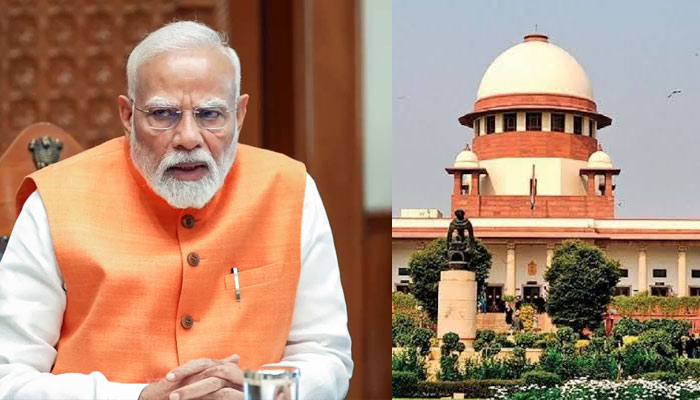
SC Questions CJI’s Exclusion From CEC Selection Panel; Centre Says ‘PM Can Be Trusted’
The Supreme Court on Thursday stressed that the Election Commission must not only function independently but also be perceived as independent, as it questioned the Centre over the exclusion of the Chief Justice of India (CJI) from the selection panel for appointing the Chief Election Commissioner (CEC) and Election Commissioners (ECs).
A bench of Justices Dipankar Datta and Satish Chandra Sharma observed that the CJI is part of selection committees for constitutional and statutory posts such as the CBI Director and the Lokpal, and asked why a different approach had been adopted for appointments to the Election Commission.
The bench reserved its verdict on the Centre’s plea seeking referral of the matter to a Constitution Bench.
Centre Defends 2023 Law
The court is hearing petitions challenging the constitutional validity of the Chief Election Commissioner and Other Election Commissioners (Appointment, Conditions of Service and Term of Office) Act, 2023.
Under the law, the President appoints the CEC and ECs based on the recommendation of a three-member selection committee comprising:
The Prime Minister
The Leader of the Opposition in the Lok Sabha
A Union Cabinet minister nominated by the Prime Minister
The legislation replaced the Chief Justice of India on the panel with a Cabinet minister, prompting legal challenges over its impact on the independence of the Election Commission.
‘People Must Trust the Prime Minister’
Appearing for the Centre, Solicitor General Tushar Mehta defended the law, arguing that there should be no presumption that the Prime Minister would act contrary to constitutional or democratic principles.
“People must trust the Prime Minister. The office carries its own sanctity,” Mehta submitted, adding that every constitutional institution functions on the assumption that public authorities will discharge their duties in good faith.
He argued that questioning Parliament’s framework on the assumption of bias would undermine constitutional governance, adding that if such reasoning were accepted, even executive appointments would require external oversight.
Attorney General R. Venkataramani also urged the court to respect Parliament’s legislative wisdom, contending that a law cannot be declared unconstitutional simply because another model may also be workable.
Court Raises Institutional Concerns
The bench clarified that it was not questioning the integrity of the Prime Minister, but examining whether the appointment process provides sufficient institutional safeguards to preserve the Election Commission’s independence.
The judges observed that the credibility of the poll body depends not only on its actual independence but also on public confidence in the fairness of the appointment process.
The bench also referred to earlier judicial observations on criminalisation in politics, asking how many serving ministers currently face pending criminal cases and noting that the government had previously assured the court it would avoid appointing individuals with criminal backgrounds to positions of responsibility.
Background
In March 2023, a five-judge Constitution Bench of the Supreme Court had ruled that, until Parliament enacted a law, appointments to the Election Commission should be made by a committee comprising the Prime Minister, the Chief Justice of India and the Leader of the Opposition.
Later that year, Parliament enacted the 2023 law, replacing the CJI with a Cabinet minister on the selection panel. The legislation is now under challenge before the Supreme Court, with petitioners arguing that it weakens the institutional independence of the Election Commission.
Comments are closed.