
Climate Change May Have Triggered Glacier Collapse Behind Devastating Nepal Floods: Scientists
A 7.8-magnitude earthquake in 2015 that struck the same mountain may also have contributed by weakening the underlying bedrock, although scientists say its exact role in the glacier collapse remains uncertain.

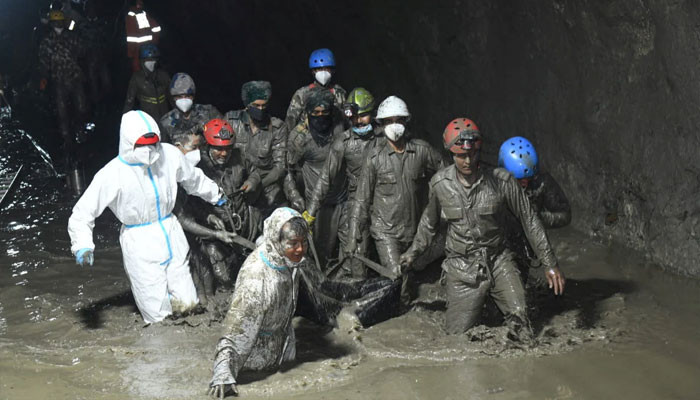
Human-driven climate change likely played a significant role in the glacier collapse that triggered devastating floods across parts of Nepal and Tibet in late August, scientists said on Thursday.
The disaster occurred after a massive section of rock and glacier ice collapsed from Langtang Lirung mountain, sending huge amounts of water and debris downstream. The floods reportedly killed around 1,400 people, while thousands remain missing.
Researchers from the World Weather Attribution (WWA) said rising temperatures in the Himalayas have accelerated glacier thinning and contributed to the thawing of permafrost deep within the region’s mountain slopes.
Warming Created Conditions for Collapse
Scientists said it remains difficult to determine exactly how much climate change contributed to the collapse of roughly 2 square kilometres of rock wall and glacier ice. However, they said prolonged warming created conditions that made the slope increasingly unstable.
“There’s absolutely no doubt that human induced climate change played a role here in the preconditioning of the disaster,” said Friederike Otto, a climatologist at Imperial College London.
According to the researchers, warming has contributed to permafrost thaw, glacier retreat and a shift from snowfall to rainfall, all of which can affect the stability of high-altitude slopes.
The WWA conducts attribution studies using peer-reviewed scientific methods to assess how climate change influences extreme weather events.
Himalayan Temperatures Far Above Normal
The study found that average temperatures across the Himalayan region were around 5°C above normal in August, with climate change accounting for approximately 1.5°C of the increase.
Scientists also pointed to unusually heavy snowfall during October and November last year. The additional snow increased the amount of water available for melting once temperatures rose, potentially adding to the forces that preceded the collapse.
The researchers said Himalayan glaciers have been losing around half a metre of thickness every year since 2000. Continued glacier retreat is changing the stresses acting on surrounding rock, while thawing permafrost may further reduce the strength of mountain slopes.
2015 Earthquake May Have Weakened Mountain
The region had already experienced a major geological shock when a 7.8-magnitude earthquake struck in 2015. Scientists said the earthquake may have weakened the underlying bedrock at the mountain, although its exact contribution to the recent collapse cannot yet be established.
Walter Immerzeel, a mountain hydrologist at Utrecht University, said the slope was already geologically vulnerable and may have been affected by the 2015 earthquake.
He said the slope was subsequently destabilised by continued glacier and permafrost retreat, increased meltwater and exceptionally high temperatures before the collapse.
The findings underline the growing concerns over the stability of Himalayan mountain slopes as rising temperatures accelerate changes in glaciers, snow cover and permafrost.
Comments are closed.