
Rain, injury and fate: Karthik Unnikrishnan’s Asian Games dream ends in sixth place

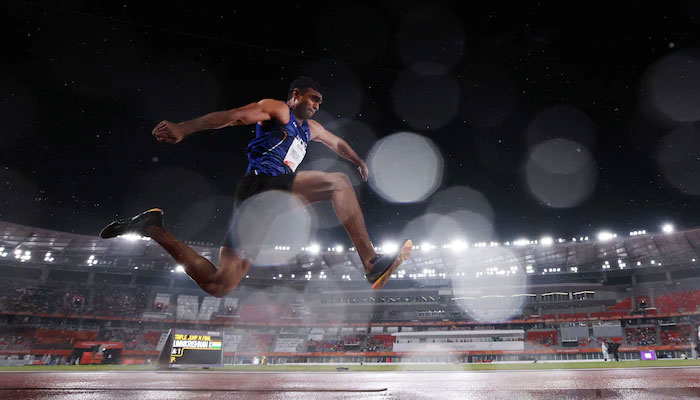
At 33, Karthik Unnikrishnan’s Asian Games dream ends in the rain
The rain had turned the runway at Nagoya City Mizuho Park Athletic Stadium into a difficult challenge. It fell steadily as Karthik Unnikrishnan prepared for the biggest competition of his career — an Asian Games debut that came at an age when many triple jumpers are already considering the twilight of their careers.
At 33, Karthik had finally reached the continental stage he had waited years for. He had spent much of his career wondering whether the opportunity would ever come.
Then came another blow.
Praveen Chithravel, India’s 2022 Asian Games bronze medallist, pulled up with a muscle injury in the opening round and was unable to complete a jump. With Chithravel out, the responsibility of carrying India’s challenge in the triple jump suddenly rested on Karthik.
It was hardly the debut he had imagined. But very little in Karthik’s career has gone according to plan.
A modest beginning in Kerala
Born in 1993, Karthik has been part of India’s triple-jump scene since 2015. His late arrival on the international stage was not because he discovered athletics late, but because circumstances repeatedly slowed his progress.
His parents ran a tea shop in Ooty, while Karthik grew up with his maternal grandparents in Kerala. Academics did not come easily to him, and when his family saw a six-foot-tall youngster searching for direction, sport became a natural choice.
At Parali High School in Palakkad, he initially tried the hurdles but struggled to find his footing. Living away from his parents and failing to find success in either studies or sport, he began battling self-doubt.
He cried. He felt isolated.
A move to the triple jump brought occasional success, but his progress stalled at the state level. Eventually, Karthik lowered his ambitions. Instead of measuring himself against the country’s best, he set himself a simpler goal: wearing the Kerala jersey.
- An accidental breakthrough
- His career changed almost by chance.
Called up as an injury replacement at a national meet, Karthik unexpectedly finished second. The performance caught the attention of coach P.G. Manoj, who offered him advice that would reshape his career: secure a job first and then build from there.
The opportunity came through the sports quota in the Indian Air Force.
For Karthik and his family, it was a major breakthrough. His family initially misunderstood the opportunity, jokingly assuming an Air Force job meant he would be flying aircraft.
Instead, the Air Force provided Karthik with something even more important — a professional sporting environment.
Domestic medals were no longer the final destination. Training alongside athletes with national and international ambitions gradually changed his own expectations. His targets moved from 15 metres to 16, then to 17.
The Asian Games and the Olympics began to look like achievable goals rather than distant dreams.
- When setbacks became a burden
- But bigger dreams also meant bigger disappointments.
- The setbacks kept coming.
The Covid-19 lockdowns left Karthik stranded in Patiala, away from his support system. His post-pandemic recovery and the absence of his coach affected his preparations for the Tokyo Olympic trials.
Then came another cruel interruption.
An ankle injury during the Commonwealth Games trials ruled him out just after he had joined the elite group of Indian triple jumpers to clear 17 metres.
In 2023, a serious tendon injury caused such a disruption to his muscle coordination that Karthik and his physiotherapist, Garima — who later became his wife — had to rebuild his technique from the ground up.
Each setback had its own explanation: illness, injury, timing or circumstance. Together, however, they became a psychological burden.
Every new trial carried memories of the previous disappointment. Every runway came with the weight of another missed opportunity.
By the time Karthik rebuilt his body and believed he was capable of a 16.80m effort, he was 33 and carrying nearly a decade of near-misses with him to Nagoya.
A final battle with fate
The rain continued as Karthik stepped onto the runway for his six attempts.
He crossed the 16-metre mark only once and eventually finished sixth.
On paper, it was another missed opportunity. But Karthik’s story is much bigger than the result in Nagoya.
For years, he has fought a quiet battle against circumstances that seemed to move the finish line every time he got close. Sometimes it was an injury. Sometimes illness. Sometimes poor timing. In Nagoya, it was the rain and a difficult runway.
For an athlete, such moments are magnified beneath the stadium lights. But they are also familiar to anyone who has dealt with missed chances, bad timing and plans that refuse to work out.
Destiny may have had the final say in Nagoya. Yet Karthik’s journey is not defined by a single jump or a sixth-place finish.
It is defined by the fact that he kept returning to the runway.
At 33, after years of setbacks, he finally got his Asian Games moment. It did not end with a medal. But it did end with Karthik doing what he had done throughout his career — showing up, taking his chance and walking away with his head held high.
Comments are closed.