
Sheikh Hasina Says She Will Return To Bangladesh By December, Raises Questions Over Extradition

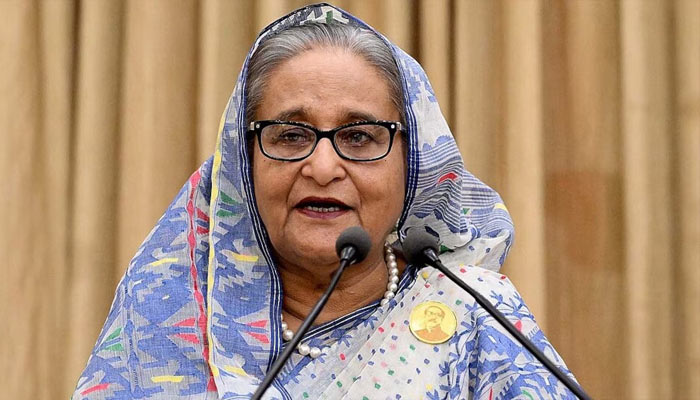
Sheikh Hasina Plans Bangladesh Return By December, Questions Extradition Demand
Former Bangladesh Prime Minister Sheikh Hasina has said she plans to return to Bangladesh by December, while questioning Dhaka’s decision to make her extradition a condition for a possible visit to India by BNP leader and Prime Minister Tarique Rahman.
In an exclusive telephonic interview with Hindustan Times, Hasina said her return would be based on her own decision and insisted that she did not intend to remain outside Bangladesh permanently.
‘I Will Go Back’: Hasina
Reacting to Bangladesh’s reported demand for her extradition, Hasina questioned why her political remarks made in India should affect relations between New Delhi and Dhaka.
“I addressed a press conference at an international forum. How can this be a problem for relations between two countries?” she said.
Hasina also referred to Tarique Rahman’s political activities during his years in Britain, questioning why she had not previously sought intervention from the British government.
She said she had made up her mind to return to Bangladesh and would announce the exact date, time and entry point later.
“I want to go back on my own to my country. I will go back,” she said, adding that she could not stay abroad indefinitely.
Hasina Accuses Govt Of Political Persecution
Hasina alleged that Awami League leaders and workers were facing arrests, violence and persecution, while cases were being filed against party members and attacks were being carried out on their homes.
She accused the authorities of using the extradition issue for political purposes but said legal and diplomatic procedures would continue independently.
Hasina also linked her proposed return to what she described as Bangladesh’s worsening political and economic situation.
Citing economic figures, she claimed Bangladesh’s economy expanded from roughly $70 billion to $450 billion during her tenure, while per capita income increased from $482 to $2,784.
She alleged that GDP growth had subsequently fallen to 2.22 per cent from 6.80 per cent, while industrial growth had turned negative and poverty and unemployment had risen.
Hasina Defends Awami League
Hasina defended the Awami League’s historical role in Bangladesh and questioned the decision to ban the party.
“Why did they ban the Awami League?” she asked, arguing that the party’s performance should ultimately be judged by voters through an election.
She claimed the party continued to enjoy public support despite what she described as widespread action against its members.
Hasina said she remained in touch with Awami League leaders and workers. Decisions about the return of party members, she said, would depend on consultations within the party and an assessment of the security situation.
She also claimed that more than 600 cases had been filed against her and described the judiciary as being used for political revenge.
“My return is not about power. It is about standing beside the people,” she said.
Questions $2.3 Billion Chinese Fighter Jet Deal
Hasina also questioned Bangladesh’s reported $2.3-billion plan to acquire Chinese J-10CE fighter aircraft, arguing that the country was facing economic pressures and shortages.
She highlighted her government’s expansion of electricity generation to nearly 29,000 MW and said power had been extended to households across the country.
Hasina claimed Bangladesh was now facing difficulties in securing commodities needed for power generation and pointed to gas shortages that had reportedly affected fertiliser production.
“In such difficult circumstances, why this indulgence of acquiring fighter jets?” she asked, while saying the BNP government should also answer the question.
On the Teesta project, Hasina said her government had discussed cooperation with India but declined to comment on the current administration’s approach.
Raises Concerns Over Extremism
Hasina also endorsed her son Sajeeb Wazed Joy’s warning that Bangladesh could become “another Pakistan”, saying it was intended as a serious warning about the country’s security situation.
She alleged that extremism, communal politics, terrorist networks and political patronage were growing while institutions and counter-terrorism capabilities were being weakened.
She also expressed concern over reported attacks on shrines, dargahs, sculptures and cultural and secular spaces.
According to Hasina, a revival of extremist networks could create wider regional consequences for India, Myanmar and the Bay of Bengal, including in areas such as trade, migration, maritime security and counterterrorism cooperation.
India Examining Extradition Request
India’s External Affairs Ministry spokesperson Randhir Jaiswal said on August 18 that any extradition request was being examined through established processes.
He said India remained committed to positive, constructive and forward-looking relations with Bangladesh based on mutuality of interest and reciprocity.
Jaiswal also said India had extended a cordial invitation to Prime Minister Tarique Rahman to visit India. Bangladesh’s Foreign Ministry separately said officials from both countries had been discussing a possible bilateral visit for several weeks.
Dhaka had linked the process to Hasina’s August 5 interaction in New Delhi. India has previously clarified that the event was organised by a private media organisation and was neither organised nor endorsed by the Indian government.
‘I Follow Developments Every Day’
Despite living in India, Hasina said her attention remained firmly focused on Bangladesh.
“I follow developments in Bangladesh every day,” she said, referring to her continued interest in Awami League members, their families, the economy, law and order, minority safety and the concerns of young people.
She said what she missed most was the people of Bangladesh, their language and the rural landscape where she had spent much of her life.
Comments are closed.