
Sony’s ‘Ace’ outplays national stars, raises bar for AI in table tennis

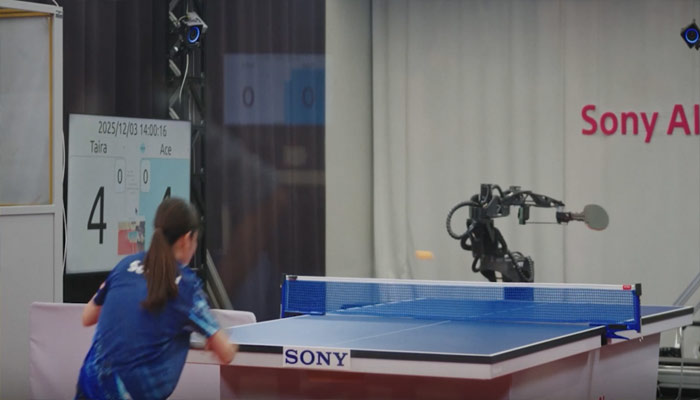
Sony has built a table tennis robot capable of beating elite human players
An advance researchers say could mark a major step forward for robotics in tasks that demand speed, precision and real-time decision-making. The robot, ‘Ace’, didn’t just hold its own—it outplayed several national-level competitors in controlled matches, underlining its ability to operate in one of sport’s fastest environments.
Developed by Sony AI, Ace goes far beyond conventional training machines. Equipped with an eight-jointed robotic arm and a paddle, it is designed to handle the pace, spin and unpredictability of real competition. In official matches, it defeated three out of five players who had competed at national tournaments and major events.
The contests followed standard rules, with equipment certified by the International Table Tennis Federation and overseen by human referees. Each game was played to 11 points. Against two professional-level players, however, Ace fell short—suggesting that the very top tier of the sport still remains beyond its reach.
Table tennis presents a unique challenge for machines. The ball can exceed 70 km/h, often carrying heavy spin that alters both trajectory and bounce. Reading that spin—and reacting in time—demands rapid anticipation and exceptional control.
Ace tackles this using a high-speed vision system powered by 12 cameras with Sony sensors, allowing it to track the ball’s position, velocity and rotation in real time. Its movements are shaped by deep reinforcement learning, enabling it to deploy around 15 types of serves and sustain rallies with consistency. During testing, rallies averaged five shots, with the robot frequently returning the ball faster than its opponents expected.
It also handled spin-heavy exchanges and unpredictable net-cord deflections—situations where even experienced players struggle for consistency. That reliability proved decisive against national-level opponents, though professional players were still able to expose its limitations.
The findings, published in Nature on April 23, place Ace among the most advanced robotic systems to compete in a real sport setting. Earlier table tennis robots had not been able to consistently challenge skilled human players under official conditions.
According to Sony AI chief scientist Peter Stone, the implications extend beyond sport. Systems like Ace could be applied in environments where machines must react instantly and operate with precision alongside humans.
Comments are closed.