

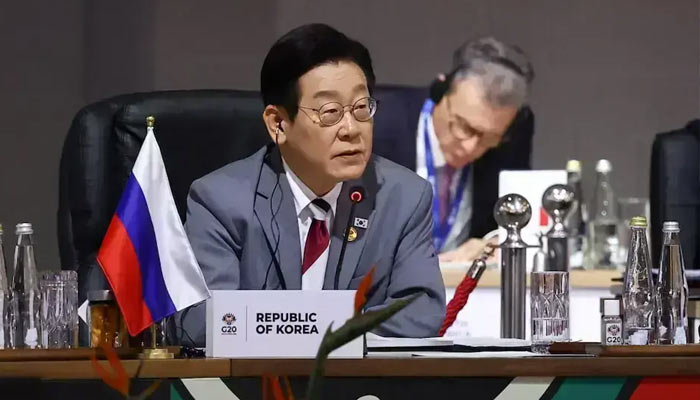
South Korean President Lee Jae Myung will travel to Turkiye next week to attend the NATO summit in Ankara before embarking on a state visit to Mongolia.
As Seoul seeks to deepen defence cooperation and strengthen strategic ties with key regional partners. Announcing the visit on Friday, National Security Adviser Wi Sung-lac said Lee will participate in the NATO summit on July 7 and 8, where he is expected to promote South Korea’s defence industry and expand cooperation with NATO member states.
During the summit, Lee will hold talks with NATO Secretary General Mark Rutte and join a meeting of Indo-Pacific partner countries, including Japan, Australia and New Zealand. He is also scheduled to attend the NATO Defence Industry Forum and deliver remarks at one of its sessions.
“As geopolitical instability deepens, NATO members are increasing defence spending while strengthening their domestic defence production capabilities,” Wi said.
“Although South Korea is not a NATO member, it is important to strengthen partnerships based on NATO standards to support exports of South Korean defence equipment,” he added.
Wi also said the presidential office is working to arrange additional bilateral meetings with world leaders on the sidelines of the summit to discuss defence cooperation, though no further details were disclosed.
Following the NATO summit, Lee will travel to Mongolia for a three-day state visit beginning July 9 at the invitation of President Khurelsukh Ukhnaa.
On the opening day of the visit, the two leaders will hold a bilateral summit, issue a joint statement and oversee the signing of several memorandums of understanding aimed at expanding cooperation across multiple sectors.
According to Wi, South Korea considers Mongolia a key strategic partner because of its abundant reserves of critical minerals and its potential role in promoting stability on the Korean Peninsula through its close diplomatic ties with North Korea.
The back-to-back visits underscore Seoul’s efforts to expand its diplomatic outreach, bolster defence partnerships and secure cooperation in strategically important sectors, including critical mineral supply chains.
Comments are closed.