

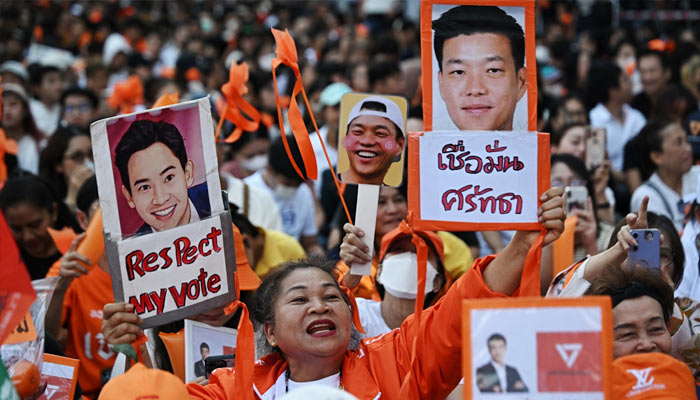
Thai voters will head to the polls on Sunday after the country cycled through three prime ministers in less than three years.
With a three-way contest expected to determine the leadership of the Southeast Asian nation for the next four years. For the first time in Thailand’s history, nearly 53 million eligible voters in a population of about 71 million will elect 500 lawmakers and vote in a referendum on whether the country should draft a new constitution.
The snap election was called in December by Prime Minister Anutin Charnvirakul — the third premier since the 2023 election — after he dissolved the House of Representatives to avert an impending no-confidence vote.
More than 5,000 candidates from 57 political parties are contesting the election. Of the 500 seats in the House, 400 will be directly elected from constituencies, while 100 will be allocated from party lists based on proportional representation. The new House will then vote to choose the prime minister.
“This election is a gamble on the future of Thailand,” said Lawan Sarovat, a 60-year-old Bangkok resident. “In the past decade, I have never seen the country move backward as much as it has.”
Thailand has endured prolonged political instability, compounded by an economy stuck at roughly 2 per cent growth for five years and a border conflict with Cambodia last year that killed more than 100 people and caused losses of at least $436 million.
“We had hoped the previous election would bring real change, but that didn’t happen,” Sarovat said. “This time, people must make their voices heard.”
Main contenders
Sunday’s vote pits Anutin’s Bhumjaithai Party — backed by Thailand’s royalist conservative establishment — against the progressive, youth-driven People’s Party and Pheu Thai, a once-dominant force linked to former prime minister Thaksin Shinawatra, who is currently jailed.
A nationwide survey by the National Institute of Development Administration placed People’s Party leader Natthaphong Ruengpanyawut first in the prime ministerial race with more than 29 per cent support, followed by Anutin at over 22 per cent.
The People’s Party also led in overall party preference, backed by 33.5 per cent of respondents in the January poll of 2,500 people. Bhumjaithai and Pheu Thai followed with about 22.7 per cent and 16.9 per cent, respectively.
The People’s Party is the successor to Move Forward, which won the most seats in the 2023 election with the backing of 14 million voters but was blocked from forming a government and later dissolved by the Constitutional Court over its proposals to amend Thailand’s strict royal insult laws.
“Elections in Thailand are not simply about voting,” said Senator Tewarit Maneechai. “They are shaped by multiple surrounding factors.”
Even with electoral success, parties must win acceptance from powerful independent bodies established under the current constitution, including the Senate, the Constitutional Court and the National Anti-Corruption Commission — institutions widely seen as extensions of the power structure that emerged after the 2014 military coup.
Under this system, elected governments can be removed at any time. Maneechai pointed to the removal of Pheu Thai’s Paetongtarn Shinawatra as prime minister in August 2025 following a Constitutional Court ruling, a decision that fuelled public concern over the growing reach of unelected agencies.
“Only parties that operate within the rules designed by the coup-era power structure are allowed to govern,” Maneechai said.
Constitutional referendum
Voters will also decide whether Thailand should replace its military-backed 2017 constitution.
The referendum asks a single question: whether voters approve the drafting of a new constitution, with options of “Yes,” “No,” or “No opinion.” At least 17 million votes in favour would be required to give the result nationwide legitimacy, Maneechai said.
While a “Yes” vote would trigger a multi-stage drafting process, two additional referendums would still be required before a new charter could be adopted. “The referendum matters because even if a party wins, its survival in office still depends on institutions empowered by the current constitution,” Maneechai said.
Change versus status quo
Many voters see the election as a rare opportunity to challenge entrenched power. “Thai politics is operating under rules controlled by an authoritarian camp,” said Jamza Jongkham, a 27-year-old voter. “What happened to Move Forward was fundamentally unfair.”
Millennials and Generation Z together make up about 46.5 per cent of eligible voters, a demographic that has largely rallied behind reformist parties. “I still believe people’s voices matter,” Jongkham said. “If we stay silent, Thailand will only get worse.”
Political scientist Puangthong Pawakapan of Chulalongkorn University said the election is unlikely to deliver a decisive break but will reflect an intensifying struggle between voters and entrenched elites.
“This election has clearly divided Thai society into two camps — those who want change and those who want to preserve the status quo,” she said. “The public increasingly understands that the country’s political and economic problems are rooted in an old power structure that is extremely difficult to dismantle.”
Comments are closed.