

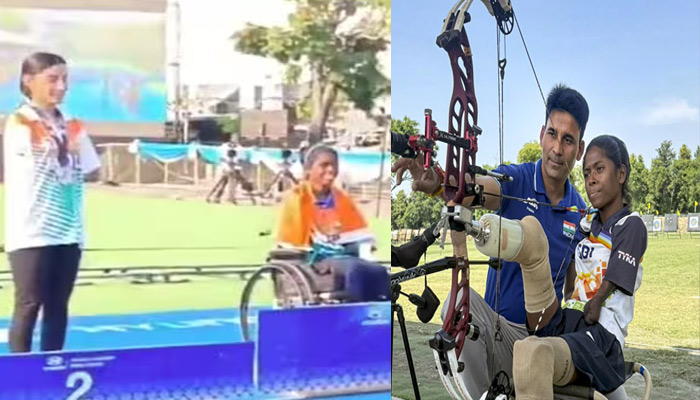
As the first notes of the national anthem echoed through the Bangkok Archery Centre on Saturday, the scoreboard captured a surprise:
Payal Nag 139, Sheetal Devi 136. But the moment that defined the World Archery Para Series had little to do with numbers. On the podium stood two athletes bound by resilience and shared history. Payal Nag, just 18, wore the gold with quiet composure. Beside her was Sheetal Devi, the world’s most celebrated para-archer and a symbol of India’s rise in the sport.
As the anthem played, Payal—unable to turn towards the tricolour due to her condition—remained facing away. Before officials could step in, Sheetal gently intervened. With practiced ease, she used her leg to turn Payal’s wheelchair so she could face the flag. It was instinctive, thoughtful, and deeply moving—a champion’s gesture that transcended competition.
Payal’s journey to that podium is nothing short of extraordinary. Hailing from Odisha’s Balangir district, she lost all four limbs in an electrocution accident at the age of eight. What followed could have been a life defined by limitations. Instead, Payal found expression through art, learning to paint using her mouth.
That talent changed her life. A video of her artwork reached coach Kuldeep Vedwan, a key figure in India’s para-archery ecosystem. Along with Abhilasha Chaudhary, Vedwan has been instrumental in nurturing unconventional talent at the Mata Vaishno Devi Shrine Board Sports Complex in Katra. He is also the mentor behind Sheetal Devi’s remarkable rise.
Recognising Payal’s potential, Vedwan introduced her to archery and helped develop a customised technique suited to her abilities. While Sheetal shoots using her feet and mouth, Payal relies on a specialised support system combined with a mouth-operated trigger. The precision required is immense, leaving little room for error.
In Bangkok, the student rose to challenge the benchmark. Sheetal entered the final as the favourite, but Payal remained unfazed. The contest stayed tight until the latter stages, where the teenager’s composure made the difference. With steady execution, she edged ahead to claim gold on her international debut.
It was a breakthrough that hinted at a changing of the guard. Payal had previously bested Sheetal at the 2025 Para Nationals, but doing so on a global stage added a new dimension to her arrival.
India finished the event with a dominant medal haul, but the lasting memory was that brief, powerful exchange on the podium. In a sport where every point is fiercely contested, Sheetal’s gesture stood out as a reminder of something larger.
By helping Payal face the flag, she wasn’t just assisting a fellow athlete—she was acknowledging the journey, the struggle, and the promise of what lies ahead.
Comments are closed.