
UN Security Council Members Criticize Israel’s West Bank Plans Ahead of Donald Trump’s Board of Peace Meeting

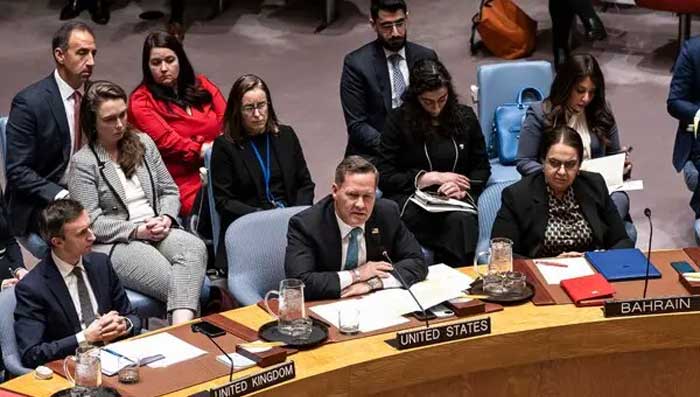
Members of the United Nations Security Council on Wednesday urged that the Gaza ceasefire be made permanent and sharply criticized Israel’s moves to expand control in the West Bank, warning they could undermine prospects for a two-state solution.
The meeting came a day before President Donald Trump’s inaugural Board of Peace session in Washington focused on the future of the Palestinian territories.
Originally set for Thursday, the Security Council session was moved forward after Trump announced his board’s gathering for the same day, creating scheduling conflicts for diplomats. The shift highlighted the potential for overlapping priorities between the UN’s most powerful body and Trump’s new initiative, which some governments view with caution amid concerns it could sideline established multilateral processes.
Pakistan — the only Security Council member to also accept an invitation to join the Board of Peace — condemned Israel’s settlement activities in the West Bank. Foreign Minister Ishaq Dar described Israel’s recent decisions as “null and void” and a “clear violation of international law.”
“Israel’s recent illegal decisions to expand its control over the West Bank are gravely disturbing,” Dar told the council.
Senior diplomats from the United Kingdom, Israel, Jordan, Egypt and Indonesia attended the monthly Middle East meeting, convened after Arab and Islamic nations requested discussions on Gaza and the West Bank ahead of travel to Washington.
Palestinian UN Ambassador Riyad Mansour warned that annexation would breach international law and threaten ongoing peace efforts. Israeli Foreign Minister Gideon Saar dismissed the criticism, arguing the council was driven by what he called an “anti-Israeli obsession” and asserting Israel’s historical claims to the territory.
Saar also suggested global attention would center on Trump’s Board of Peace rather than the UN proceedings.
Debate Over the Board of Peace
Trump’s Board of Peace was initially framed as a small group of leaders tasked with advancing a 20-point Gaza framework. Its expanded ambition to address conflicts worldwide has drawn mixed reactions. While more than 20 countries have reportedly agreed to participate, several close US allies, including France and Germany, have yet to join, reiterating support for the United Nations.
British Foreign Secretary Yvette Cooper said the Security Council still has a critical role in fostering stability. “Gaza must not get stuck in a no man’s land between peace and war,” she said.
US Ambassador to the UN Mike Waltz defended the new initiative, appearing to contrast it with traditional diplomacy. “The board is not talking, it is doing,” Waltz said, criticizing what he described as ineffective “old ways.”
The Security Council met a day after most of its members — excluding the United States — joined dozens of diplomats in backing a statement condemning Israel’s recent West Bank actions and expressing strong opposition to annexation.
In recent weeks, Israel has advanced a controversial land regulation process that officials say will deepen its authority in the occupied territory. Critics, including Palestinian leaders and human rights groups, argue the measures amount to de facto annexation. Israeli ministers have defended the policy as consistent with national security and historical claims.
Ceasefire and Uncertain Next Steps
The council also reviewed the US-brokered Gaza ceasefire that took effect on Oct. 10. UN political chief Rosemary DiCarlo, along with Israeli and Palestinian civil society representatives, addressed the chamber in a rare joint briefing format.
Hiba Qasas of the Principles for Peace Foundation and Nadav Tamir of J Street Israel both emphasized that a negotiated two-state framework remains the only viable path to lasting peace.
“Our futures are interdependent,” Tamir said. “Israel cannot remain a democratic homeland for the Jewish people if Palestinians are denied a homeland of their own.”
DiCarlo described the current period as “a pivotal moment in the Middle East,” cautioning that progress would depend on political decisions in the coming weeks. She called the Board of Peace meeting “an important step.”
While aspects of the ceasefire have advanced — including hostage releases and increased humanitarian aid flows — major challenges remain. Key unresolved issues include Gaza’s reconstruction, the potential deployment of international security forces, and the future role of Hamas.
Trump said this week that participating countries had pledged $5 billion for Gaza’s rebuilding and would contribute personnel for stabilization missions, though details were not disclosed. Indonesia’s military has indicated that thousands of troops could be prepared by mid-year for a possible humanitarian deployment, contingent on international agreements.
Comments are closed.