

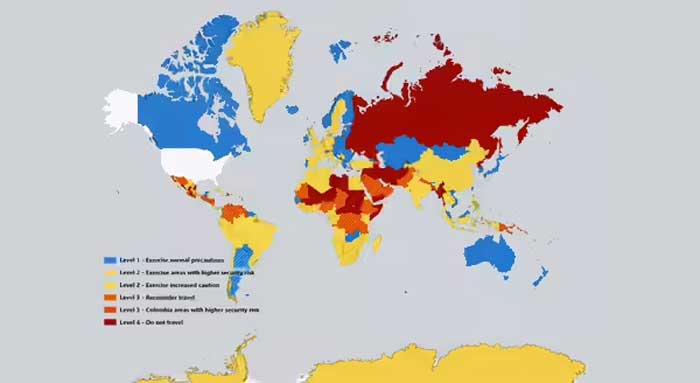
As the conflict involving Iran continues to reshape global security conditions, the United States Department of State has issued updated travel advisories, warning that American citizens overseas could face risks ranging from arbitrary detention to violence and kidnapping.
The revised guidance, reflected in the department’s global advisory map, places several countries at the highest risk level while raising caution across parts of the Middle East and beyond, as geopolitical tensions and recent military developments affect travel safety.
How the four-level advisory system works
The State Department classifies countries under a four-tier system to indicate risk levels for American travellers:
- Level 1 — Exercise normal precautions: The lowest level, indicating relatively stable conditions, though some risk exists in all international travel.
- Level 2 — Exercise increased caution: Signals heightened safety and security risks that vary by country.
- Level 3 — Reconsider travel: Indicates serious risks, urging Americans to reassess the need for travel.
- Level 4 — Do not travel: The highest level, issued when life-threatening risks exist and US government assistance may be limited or unavailable.
Iran and conflict zones at highest risk
Iran has been designated Level 4: Do Not Travel, with the State Department citing risks including terrorism, unrest, kidnapping, arbitrary arrest of US citizens and wrongful detention.
The designation comes amid ongoing hostilities involving the United States and its allies, including strikes on Iranian military and strategic sites in recent months.
Other countries in the Level 4 category include Afghanistan, Haiti, Iraq, Libya, Russia, Somalia, Sudan, Ukraine and Yemen—many of which have limited or no US consular presence. The State Department has also flagged Russia for a history of wrongful detention of American nationals.
Middle East advisories raised
Several Gulf countries—Saudi Arabia, Oman, Kuwait and Bahrain—have seen their advisory levels raised to Level 3: Reconsider Travel, reflecting concerns about spillover effects from the Iran conflict.
Other nations currently at Level 3 include Colombia, Honduras, Israel, Nicaragua, Qatar, the United Arab Emirates and Venezuela.
Wider global caution
Countries under Level 2: Exercise increased caution include Cuba, the Dominican Republic, France, Greenland, Italy, Mexico and the United Kingdom.
Within Mexico, advisory levels vary by region: states such as Sinaloa and Colima are classified as Level 4 due to cartel violence, while Jalisco and Baja California fall under Level 3.
Global alert and threats
Alongside the updated advisories, the State Department issued a worldwide security alert urging Americans to remain vigilant due to potential threats linked to Iran.
The warning followed remarks by Iranian military spokesperson Abolfazl Shekarchi, who suggested that even public spaces such as parks and tourist sites could become unsafe amid escalating tensions.
Guidance for travellers
The State Department advises Americans travelling abroad to enrol in the Smart Traveler Enrollment Program (STEP), which provides real-time updates and alerts from US embassies and consulates.
Officials stress that conditions can change rapidly, particularly in conflict-affected regions, and travellers should closely monitor updates before and during any international trip.
Comments are closed.