
US Treasury Chief Urges G20 to Consider More Trade Barriers Against China

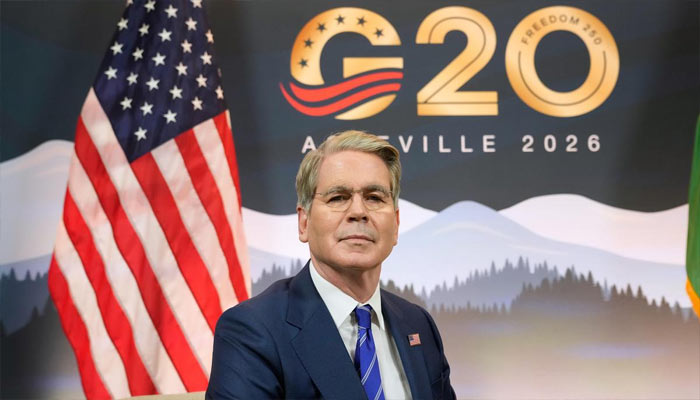
US Treasury Secretary Scott Bessent is set to push G20 countries to take a tougher, coordinated approach toward China’s trade practices, calling for measures.
That could help correct global economic imbalances and encourage Beijing to rely less on exports. Ahead of a meeting of G20 finance officials, Bessent said China’s huge export surplus was becoming increasingly difficult for the global economy to absorb. He argued that China should shift its economic focus toward strengthening domestic consumption rather than attempting to solve weak internal demand through overseas sales.
“The world cannot have a China with a $1.2 trillion trade surplus,” Bessent said, describing China’s economy as weak and warning that its export-driven strategy was not sustainable.
The Treasury secretary’s comments come as Washington faces the challenge of redesigning its tariff strategy following court setbacks. US tariffs have significantly reduced the flow of Chinese goods into America, but Chinese exports have increasingly been redirected toward other markets, including Europe and Latin America.
Bessent said other major economies had been warned about the potential consequences of a surge in Chinese imports and now faced difficult decisions over how to respond. He argued that countries outside China needed to reconsider their trade arrangements with Beijing and create incentives for China to strengthen its domestic economy.
Washington is seeking support for a G20 declaration focused on reducing trade and current-account imbalances. Chinese officials had not immediately responded to the US proposal.
According to US Census Bureau figures, the US trade deficit with China fell by roughly one-third in the first half of 2026 compared with the same period last year, reaching $73.9 billion. The figures also reflect unusually strong Chinese imports early in 2025 as businesses accelerated shipments ahead of expected US tariffs.
Bessent rejected calls for a currency-focused solution, including proposals for a new version of the 1985 Plaza Accord. He questioned whether a stronger yuan would address the fundamental problems, arguing instead that China’s industrial subsidies and weak consumer demand were at the heart of the trade imbalance.
US-China talks ahead of Trump-Xi meeting
Bessent said he was unsure whether he would hold an in-person meeting with Chinese Vice Premier He Lifeng before the planned late-September meeting between US President Donald Trump and Chinese President Xi Jinping at the White House.
Officials from both countries are expected to continue negotiations on reducing tariffs on goods considered non-strategic, while also discussing safeguards for advanced artificial intelligence systems. The aim, Bessent said, includes preventing powerful AI models from reaching non-state actors.
He estimated that the US and China could potentially remove tariffs on around $30 billion worth of non-strategic and non-critical products from each side.
The talks come after the US Supreme Court rejected broad tariffs imposed under an emergency law, forcing the Trump administration to reconstruct parts of its trade policy. The administration later introduced a 12.5% tariff on Chinese imports following an anti-forced-labor investigation and is considering additional measures targeting excess industrial capacity in China.
Bessent also said he expects to meet People’s Bank of China Governor Pan Gongsheng during the G20 gathering in Asheville, although he did not disclose what would be discussed.
Comments are closed.