
World Leaders Set To Address COP31 As Turkiye Seeks Fresh Global Climate Agreement

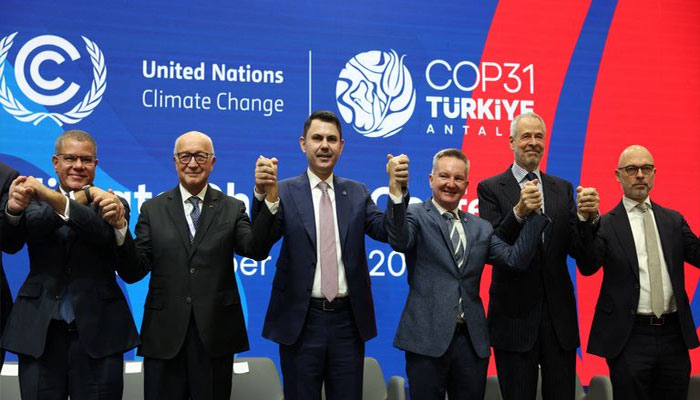
World leaders are set to outline their climate priorities at the COP31 summit in Turkiye on Wednesday.
As nearly 200 countries work towards a fresh agreement on accelerating the global energy transition. The discussions in the Mediterranean city of Antalya are focused on increasing electricity’s share in global energy consumption and reviving negotiations on reducing dependence on fossil fuels.
The summit comes at a critical time, with global greenhouse gas emissions continuing to remain high and international attention divided by conflicts, inflation and other economic challenges. A United Nations report released last month warned that the world is heading towards a breach of the 1.5-degree Celsius global warming threshold set under the 2015 Paris Agreement.
World Leaders To Push For Stronger Climate Commitments
Speeches by presidents and heads of government are expected to provide political momentum to the ongoing negotiations. According to the COP31 schedule, several world leaders will address the gathering on Wednesday afternoon, with speeches continuing throughout Thursday.
Brazilian President Luiz Inacio Lula da Silva, European Commission President Ursula von der Leyen, Chinese Vice President Han Zheng and Marshall Islands President Hilda Heine are among the prominent leaders scheduled to speak on Wednesday.
Former French Prime Minister Laurent Fabius, who chaired the 2015 Paris climate conference and heads an advisory council of former COP presidents, said the leaders’ addresses could help advance negotiations by focusing on practical implementation.
He told Reuters that the summit offers leaders an opportunity not only to announce new commitments but also to explain how they intend to fulfil them. He identified implementation as the central theme of the Antalya conference.
The United States, historically the world’s largest emitter of greenhouse gases, is absent from the summit for the second consecutive year. President Donald Trump withdrew the country from international climate cooperation after returning to office in 2025 and has repeatedly questioned the science behind global warming.
Turkiye Pushes For Greater Electrification
As the host nation, Turkiye is advocating for a target to increase electricity’s share of total global energy consumption to 35 per cent by 2035. Currently, electricity accounts for slightly more than one-fifth of worldwide energy use.
The proposed target aims to accelerate electrification across transport, manufacturing and buildings, potentially helping reduce emissions from conventional energy sources.
However, environmental campaigners and climate experts have raised concerns that increasing electricity consumption alone may not significantly reduce global warming unless the additional power comes from renewable and other low-carbon sources.
The proposal also does not establish a clear commitment to phase out coal, oil and natural gas, leaving the broader question of transitioning away from fossil fuels unresolved.
UN Chief Calls For Clear Fossil Fuel Phase-Out Roadmap
United Nations Secretary-General Antonio Guterres has urged governments to stop treating the transition away from fossil fuels as an issue that cannot be addressed through international negotiations.
Speaking at the summit on Tuesday, Guterres called on countries to establish clear timelines for reducing their dependence on coal, oil and gas.
The issue remains contentious following the previous climate conference in Brazil, where participating countries failed to reach a consensus on a global roadmap to reduce fossil fuel dependence.
However, the Brazilian COP presidency has recently released a proposed roadmap intended to keep the issue at the centre of international discussions. Under the proposal, countries would assess and plan changes to their energy systems by 2028, followed by coordinated efforts to reduce fossil fuel supplies from 2031.
With global temperatures continuing to rise, COP31 negotiations are expected to test whether participating nations can move beyond climate pledges and agree on concrete measures to accelerate the transition towards cleaner energy. [change content]
Comments are closed.