
Zakir Naik Faces Criticism From Three Countries Over Remarks Defending Taliban’s Ban on Girls’ Education

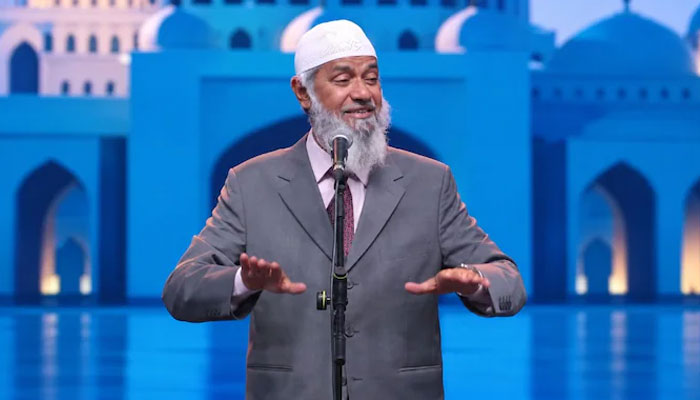
Zakir Naik Faces Backlash Across India, Pakistan and Afghanistan Over Defence of Taliban Education Policy
Controversial Islamic preacher Zakir Naik has come under criticism from journalists, activists, academics and citizens in India, Pakistan and Afghanistan after defending the Taliban’s restrictions on secondary and higher education for girls.
The controversy erupted after a video of Naik’s remarks circulated widely on social media. In the clip, he questioned media reports about Afghanistan and argued that the Taliban had not permanently banned girls from education but had merely delayed their return to classrooms.
“Everything that comes in the media is not true,” Naik said.
He further argued that delaying education until suitable teachers are available should not be considered a problem. According to him, girls can continue receiving primary education up to Class 6, while secondary and higher education remain suspended because of concerns over security and the shortage of female teachers.
Naik also claimed that Afghan women were pursuing master’s degrees and PhDs in Islamic studies and Sharia.
Malala Yousafzai’s father calls remarks deeply troubling
Naik’s defence of the Taliban’s policy drew a strong response from the father of Pakistani Nobel laureate and education activist Malala Yousafzai.
He described the preacher’s comments as “deeply troubling and disappointing”, questioning how an influential Islamic scholar could justify the exclusion of girls from education.
“It is deeply troubling and disappointing to see an Islamic scholar of such global prominence as Dr. @drzakiranaik rationalise the Taliban’s systematic exclusion of girls from education,” he said.
He also rejected the argument that a shortage of female teachers justified the restrictions, pointing out that describing an indefinite ban as a temporary postponement did not address how the problem would be resolved.
Malala has long campaigned for girls’ education and survived a Taliban shooting in Pakistan after speaking publicly against restrictions on female education.
Afghan politician mocks Naik’s argument
Exiled Afghan parliamentarian Mariam Solaimankhil responded sarcastically to Naik’s explanation, highlighting what she described as a contradiction in the Taliban’s position.
“According to Zakir Naik, Afghan girls aren’t banned from education. They’re just waiting for female teachers. The same female teachers the Taliban banned from working?” she wrote on X.
“Brilliant logic, Doctor!” she added.
Indian historian Ruchika Sharma also criticised Naik, arguing that influential religious figures should be speaking out against the restrictions imposed on Afghan women.
She described the exclusion of girls from education as a serious human rights violation and questioned the failure to condemn the Taliban’s policy.
Naik’s move from India to Malaysia
Naik left India in 2016 after investigators examining the July 2016 Dhaka café attack reportedly found that one of the attackers had been influenced by his speeches. Indian investigative agencies subsequently began examining his activities.
He moved to Malaysia in 2017, where he was granted permanent residency.
UNICEF: 2.6 million Afghan girls denied secondary education
The scale of the restrictions has also been highlighted by UNICEF. According to the organisation, more than 2.6 million Afghan girls have been denied access to secondary education since September 2021, when the Taliban returned to power.
Afghanistan remains the only country in the world where girls and women are barred from secondary and higher education, UNICEF has said.
“Five years may be brief in a country’s history, but it is a defining period in a girl’s life,” UNICEF Executive Director Catherine Russell said.
The continuing restrictions have left millions of Afghan girls without access to further education, while Naik’s remarks have reignited debate over attempts to defend or justify the Taliban’s education policies.
Comments are closed.