
20 UNESCO World Heritage Sites in India You Should Visit and Why They Matter

India has 44 UNESCO World Heritage Sites—a blend of ancient monuments, historic cities, and biodiverse landscapes. Each site highlights a different facet of the country’s cultural depth, architectural innovation, or ecological richness.
Taj Mahal (Uttar Pradesh)
Inscribed in 1983, the Taj Mahal remains India’s most iconic monument. Its perfect symmetry, delicate inlay work, and luminous marble continue to captivate visitors.
Agra Fort (Uttar Pradesh)
Built in the 16th century, Agra Fort reflects the evolution of Mughal palace architecture. Multiple emperors lived and ruled from its fortified chambers, adding layers of history.
Ajanta Caves (Maharashtra)
Set in a horseshoe-shaped gorge, the Ajanta Caves house some of the world’s oldest surviving Buddhist paintings, still remarkably vivid after two millennia.
Ellora Caves (Maharashtra)
Ellora is unique for its Buddhist, Hindu, and Jain monuments carved into a single cliff face. The standout Kailasa Temple is hewn downward from a massive rock monolith.
Elephanta Caves (Maharashtra)
Located on an island near Mumbai, these caves are renowned for their monumental sculptures of Shiva and intricately carved rock-cut chambers.
Sun Temple, Konark (Odisha)
Shaped like a colossal stone chariot, the 13th-century Sun Temple features sculpted wheels, horses, and detailed reliefs that showcase the height of Odishan temple art.
Group of Monuments at Mahabalipuram (Tamil Nadu)
These Pallava-era structures—including rock-cut shrines and the famous Shore Temple—capture early Dravidian architectural experimentation along the Coromandel Coast.
Churches and Convents of Goa
A legacy of Portuguese rule, Goa’s churches reflect European architectural styles adapted to Indian settings, marking the spread of Christianity in the region.
Fatehpur Sikri (Uttar Pradesh)
Akbar’s short-lived capital is a masterpiece of red sandstone architecture. Its palaces and courts remain strikingly intact, reflecting a fusion of styles and cultural influences.
Hampi (Karnataka)
Scattered across dramatic boulder-strewn terrain, Hampi’s ruins recall the grandeur of the Vijayanagara Empire, with remnants of markets, temples, and palatial complexes.
Khajuraho Group of Monuments (Madhya Pradesh)
These temples, famed for their intricate stone carvings, represent the pinnacle of Nagara-style architecture and depict a range of artistic themes.
Group of Monuments at Pattadakal (Karnataka)
Pattadakal blends northern and southern temple forms. The Chalukyas used this site as a canvas for architectural experimentation.
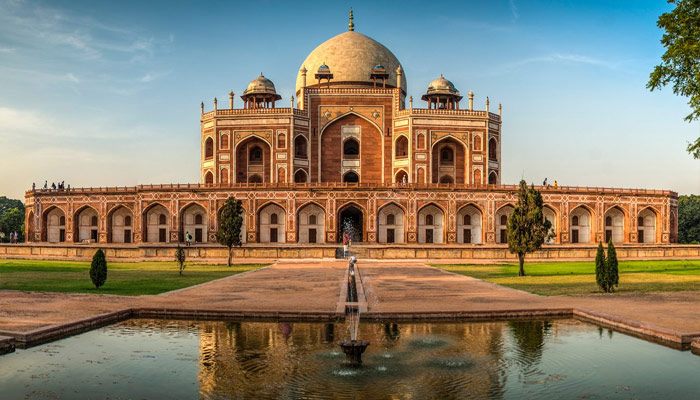
Humayun’s Tomb (Delhi)
This Persian-style garden-tomb marks the beginning of grand Mughal mausoleum design in India and served as an architectural precursor to the Taj Mahal.
Qutb Minar and Its Monuments (Delhi)
The complex features the world’s tallest brick minaret and structures that illustrate the earliest phase of Indo-Islamic architecture.
Red Fort Complex (Delhi)
Commissioned by Shah Jahan, the Red Fort became a symbol of Mughal authority and remains central to India’s political ceremonies.
Dholavira (Gujarat)
One of the most intact Indus Valley civilisation sites, Dholavira stands out for its sophisticated urban planning and water-management systems.
Kaziranga National Park (Assam)
A stronghold of the one-horned rhinoceros, Kaziranga’s wetlands and grasslands sustain diverse wildlife and support vital conservation efforts.
Keoladeo National Park (Rajasthan)
This renowned bird sanctuary hosts thousands of migratory birds each winter and shelters numerous threatened species.
Manas Wildlife Sanctuary (Assam)
Located at the Himalayan foothills, Manas is known for its rich biodiversity and protection of endangered animals such as the pygmy hog and golden langur.
Sundarbans National Park (West Bengal)
Part of the world’s largest mangrove ecosystem, the Sundarbans is home to the iconic Royal Bengal Tiger and supports a unique coastal biodiversity.
Comments are closed.