
UN Security Council Briefed on Record Child Rights Violations Amid Gaza Outcry

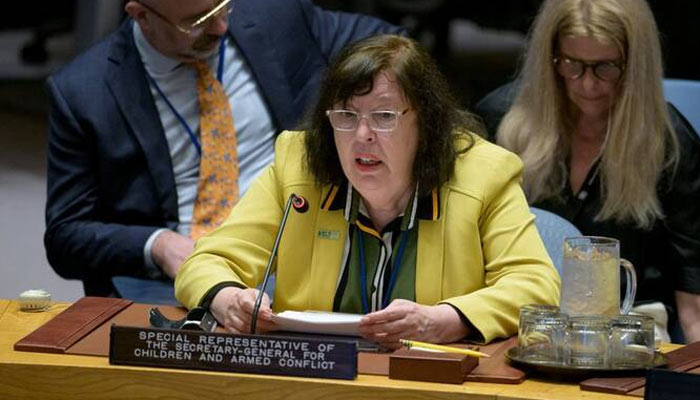
UN Security Council Sounds Alarm on Record Violations Against Children in Conflict Zones Amid Gaza Focus.
The UN Security Council convened Wednesday to confront an alarming rise in grave violations against children in conflict zones, following the release of a harrowing annual report by Virginia Gamba, the Secretary-General’s Special Representative for Children and Armed Conflict.
The report documented 41,370 verified violations in 2024—a staggering 25% increase from the previous year and the highest since the UN’s monitoring system was established in 2005. Violations included killings, maiming, abductions, sexual violence, recruitment into armed groups, attacks on schools and hospitals, and denial of humanitarian access, across 25 conflict-affected countries.
“This year marked a devastating new record,” Gamba said. “Behind these numbers are the shattered stories, dreams, and futures of over 22,000 children.”
A particularly disturbing trend was the rise in “compounded violations”—cases in which children were abducted, recruited, and sexually abused simultaneously.
Gaza: A Flashpoint in the Debate
The report revealed that Israel accounted for the highest number of violations by a single party in 2024, with over 7,000 grave violations attributed to its forces. These included more than 2,000 children killed or maimed, over 500 attacks on schools, 148 attacks on hospitals, and over 5,000 instances of humanitarian access being denied—2,263 of those in Gaza alone.
Algeria’s UN ambassador, Amar Bendjama, criticized what he called insufficient public advocacy from Gamba’s office, noting only two official statements were issued on Gaza throughout the year.
“How can we ignore the 7,188 verified grave violations attributed to Israeli forces?” he asked. “This is a man-made crisis… The children of Gaza deserve protection and accountability for those responsible.”
Bendjama also referenced data from humanitarian agencies like UNICEF, which estimate that over 50,000 children have been killed or injured in Gaza since the Israel-Hamas war began in late 2023. He highlighted the worsening humanitarian crisis, citing 5,000 cases of acute malnutrition in children under five, and the devastation of essential infrastructure.
UN Defends Reporting Framework
UN spokesperson Stéphane Dujarric defended the methodology behind the report, explaining that it only includes verified cases and likely represents just a fraction of the actual toll.
“We are very clear in saying this is just the tip of the iceberg,” he said. “Any change to the reporting mechanism would have to come from the Security Council.”
Asked about the limitations of the current monitoring system, Dujarric acknowledged that improvements were possible but emphasized that the report still serves as a vital tool to ensure children’s suffering is not ignored.
US Response: Defense of Israel, Criticism of Hamas
US representative Dorothy Shea defended Israel’s military actions and placed blame for the ongoing conflict on Hamas. She cited the October 7, 2023, attack that killed 1,200 Israelis, including 40 children, and referenced the deaths of Israeli toddlers Ariel and Kfir Bibas.
“The loss of civilian life in Gaza is tragic. But responsibility rests with Hamas, which refuses a ceasefire and continues to use civilians as shields,” she said.
She also accused Hamas of blocking aid and targeting humanitarian workers, and expressed disappointment that the report did not emphasize abuses by the militant group.
Global Failure to Protect Children
UNICEF’s Director of Child Protection, Sheema Sen Gupta, echoed the sense of urgency, declaring that “the world is failing to protect children from the horrors of war.” She reported that more than 11,900 children were killed or maimed globally in 2024, with explosive weapons in populated areas listed as the leading cause of harm.
“These are not just violations in technical terms,” she said. “They are acts of brutality that destroy lives.”
Sexual violence against children also surged by 35%, a figure believed to be vastly underreported due to stigma and fear.
Other conflict zones highlighted included Somalia, Nigeria, the DRC, and Haiti, where mass rapes and child abductions have risen dramatically. In the Democratic Republic of the Congo alone, nearly 10,000 rapes were reported in the first two months of 2025—40% involving children.
Some Progress Amid the Crisis
Despite the bleak findings, the report did note positive developments. Over 16,000 children formerly associated with armed groups were released and reintegrated. New commitments were secured from armed forces in Syria, Colombia, the Central African Republic, and Haiti to end child recruitment.
“Where there is political will, progress is possible,” said Sen Gupta.
Urgent Calls for Action
UN officials issued a series of urgent recommendations, including:
A ban on explosive weapons in populated areas
Protection of humanitarian workers and infrastructure
Stronger engagement with armed groups to implement child protection plans
Increased funding for reintegration and mental health programs
Enforcement of international humanitarian law and accountability mechanisms
Gamba concluded with a direct appeal to all governments:
“Children are not soldiers. They are not collateral damage. They are not bargaining chips. They are children—and they deserve justice, safety, and a future.”
Comments are closed.