

US, EU Strike 15% Tariff Deal to Avert Full-Blown Trade War.
The United States and the European Union have struck a framework trade agreement that imposes a 15% tariff on most EU imports—half of the previously threatened rate—averting a major trade war between the two economic giants, which together account for nearly one-third of global trade.
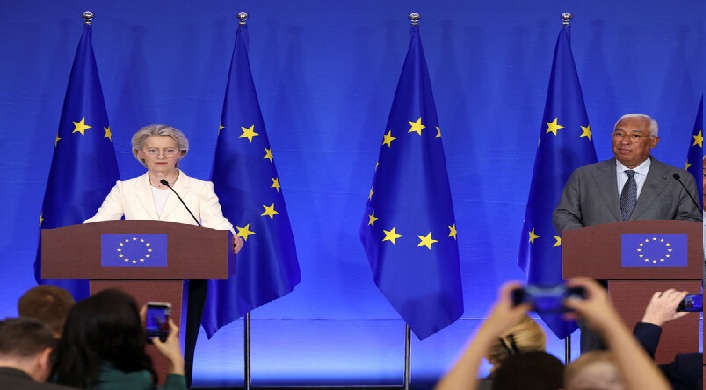
The deal was finalized during a one-hour meeting between US President Donald Trump and European Commission President Ursula von der Leyen at Trump’s golf resort in western Scotland.
“This is the biggest deal ever made,” Trump said, claiming it would lead to $600 billion in EU investment in the US and dramatically boost European purchases of American energy and military equipment.
Von der Leyen, who described Trump as a “tough negotiator,” said the 15% tariff was applied “across the board” and represented “the best we could get” under the circumstances.
The agreement comes just a week after Trump signed a $550 billion framework deal with Japan, and it is being touted as another major win by the administration. Trump also indicated the deal would lead to $750 billion in EU energy purchases and significant arms deals, though details remain sketchy.
A Win for Stability—But With Caveats
While the deal may be welcomed by sectors such as aerospace, auto, and pharmaceuticals, European leaders are divided. German Chancellor Friedrich Merz praised the agreement for averting a damaging trade conflict, particularly for Germany’s export-heavy auto industry.
However, Bernd Lange, head of the European Parliament’s trade committee, criticized the agreement as “imbalanced,” warning that the EU’s promised investments in the US could come at the expense of domestic priorities.
Notably, the deal allows Washington to raise tariffs again if the EU fails to meet its investment commitments, a US official confirmed. The current 50% US tariff on European steel and aluminum will remain in place for now, though von der Leyen said a quota system may replace it.
Key Details and Exemptions
The 15% tariff will reportedly apply to automobiles, semiconductors, and pharmaceuticals. However, several sectors will be exempt: aircraft and aircraft parts, certain chemicals, generic drugs, semiconductor equipment, some agricultural goods, and critical raw materials.
Trump initially suggested pharmaceuticals would be excluded, but US officials later clarified that they are included in the tariff agreement. Meanwhile, discussions on spirits and other goods are ongoing, with hopes to expand the product list in future talks.
Echoes of Japan Deal, With Unresolved Issues
The US-EU agreement mirrors elements of the recent US-Japan framework, which was similarly vague on key implementation details. Analysts warned that such high-level political agreements may create room for “differing interpretations,” potentially leading to future disputes.
Trump, who has long railed against what he calls Europe’s “unfair” trade practices, claimed that the EU had “wanted to make a deal very badly.” He has repeatedly cited the $235 billion US trade deficit with the EU as justification for his hardline stance.
On July 12, he had threatened to impose a 30% tariff on EU goods starting August 1. In response, the EU had prepared countermeasures worth €93 billion and discussed deploying its anti-coercion trade tools.
Comments are closed.