
Ceuta Explained: The Spanish City at the Heart of Europe’s Migrant Crisis

Ceuta Explained: Why Spain’s Tiny African Enclave Is at the Centre of a Migrant Crisis
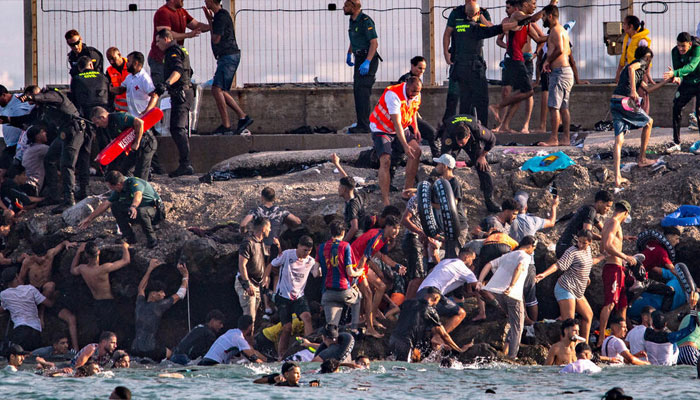
Spain’s North African enclave of Ceuta has once again become the focus of international attention after an unprecedented migrant surge left dozens dead and overwhelmed local authorities.
According to officials, at least 57 people have died attempting to reach Ceuta after as many as 50,000 migrants crossed into the Spanish territory from Morocco within 24 hours, triggering one of the biggest migration emergencies in the enclave’s recent history.
Describing the influx as “a violation of Spain’s territorial integrity,” Prime Minister Pedro Sánchez travelled to Ceuta on Friday, pledging that the government would deploy all available resources to restore order and manage the humanitarian situation.
Sánchez blamed human trafficking networks for exploiting a recent Supreme Court ruling that prevents authorities from immediately returning migrants intercepted at sea near Ceuta and Melilla. He said the decision had encouraged smugglers to spread misinformation, fuelling the sudden surge.
Spanish authorities have begun setting up temporary reception centres to register new arrivals while accelerating deportation procedures for those who do not qualify for asylum or legal residence.
Why Is Ceuta So Important?
Ceuta is a small autonomous Spanish city located on the northern coast of Africa, sharing its only land border with Morocco. Along with Melilla, it represents the European Union’s only land frontier with Africa, making it one of Europe’s most strategically sensitive border points.
Although geographically situated in Africa, Ceuta is an integral part of Spain and therefore part of the European Union. The enclave has remained under Spanish control for centuries, but Morocco continues to claim sovereignty over the territory, making it a longstanding source of diplomatic friction between the two neighbours.
Home to around 85,000 residents, Ceuta has a diverse population comprising Christians, Muslims and people of mixed Spanish and Moroccan heritage. Thousands of Moroccan workers traditionally crossed the border each day for employment and trade, highlighting the close economic ties despite the political dispute.
Migration and Diplomacy
Migration has repeatedly emerged as a point of tension between Madrid and Rabat.
In 2021, around 8,000 migrants entered Ceuta within two days after Morocco eased border controls during a diplomatic dispute with Spain. The crisis eventually subsided after relations improved and both countries resumed security cooperation.
The latest influx demonstrates how rapidly Ceuta can become the centre of both a humanitarian emergency and a diplomatic confrontation, with migration often intertwined with broader political negotiations.
A City Shaped by History
Ceuta’s strategic importance stretches back centuries. Located at the entrance to the Strait of Gibraltar, it occupies one of the world’s most significant maritime crossroads linking the Mediterranean Sea with the Atlantic Ocean.
The city was captured by Portugal in 1415 before later coming under Spanish rule, marking Europe’s first permanent territorial foothold in mainland Africa. Its location has made it a prized military and commercial outpost throughout history.
For centuries, armies crossed the narrow strait seeking conquest and expansion. Today, the same route has become one of the world’s busiest migration corridors, with thousands risking dangerous journeys in search of safety and better opportunities in Europe.
The ongoing crisis underscores Ceuta’s unique position—where geography, history and geopolitics converge—making the small enclave a recurring flashpoint in Europe’s migration debate.
Comments are closed.