
WHO Chief Warns Ebola Outbreak Is Outpacing Response Amid Aid Workers’ Strike

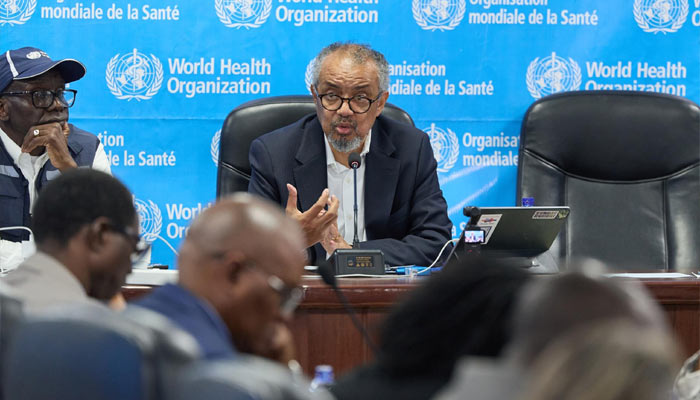
WHO Warns Ebola Outbreak Is Spreading Faster Than Response in DR Congo
The World Health Organization (WHO) has warned that the Ebola outbreak in the Democratic Republic of Congo is spreading faster than efforts to contain it, with health workers’ strikes over unpaid wages further hampering the response.
During his visit to Kinshasa on Wednesday, WHO Director-General Tedros Adhanom Ghebreyesus said the outbreak was accelerating nearly three months after it was declared. In some hotspots, the number of new infections is doubling, underscoring the need for an urgent expansion of response measures.
“We must urgently and massively scale up all our efforts across every pillar of the response,” Tedros said after meeting Congolese officials.
According to Congo’s Health Ministry, the outbreak has recorded 3,874 confirmed cases and 1,751 deaths as of Monday, making it the fastest-growing Ebola outbreak on record and the second-largest after the 2014-16 West Africa epidemic.
Health Workers’ Strike Worsens Crisis
The outbreak is centred in Ituri province, where healthcare services have been disrupted by strikes involving frontline workers demanding better pay. The region already faces severe challenges due to ongoing armed conflict and limited access to healthcare.
Some workers have reportedly begun receiving delayed payments, but many continue to demand higher wages and improved working conditions.
Residents say the strike has had devastating consequences. Bunia resident Anicet Baluku told the Associated Press that two of his brothers died from Ebola after access to treatment was affected by the industrial action, urging authorities to resolve the dispute quickly.
International Support Steps Up
The United States announced an additional $242 million in emergency assistance for Ebola response, preparedness and humanitarian relief, taking its total support for the outbreak to more than $512 million.
The current outbreak is caused by the Bundibugyo strain of the Ebola virus, for which there is no approved vaccine or specific treatment. Health officials believe the virus had been circulating in remote communities before the outbreak was officially declared on May 15.
Medical charity Doctors Without Borders (MSF) warned that although the response is expanding, it is still failing to reach affected communities quickly enough to interrupt transmission.
Contact Tracing Remains a Major Challenge
Africa CDC Director-General Dr Jean Kaseya said contact tracing remains one of the biggest weaknesses in the response, with 60-70% of newly confirmed infections occurring outside the network of known contacts being monitored.
Officials also attribute the outbreak’s high fatality rate—around 45%—to delayed diagnosis and treatment. Of the 77 new cases reported in the latest 24-hour reporting period, 44 were fatal. Meanwhile, 717 patients remain in isolation and 749 have recovered.
Tedros urged authorities and international partners to strengthen coordination, improve early detection and ensure health workers are protected. He stressed that community participation would be key to ending the outbreak.
“Communities must be at the centre of the response,” Tedros said. “We cannot stop Ebola without their trust, leadership and partnership.”
Comments are closed.