

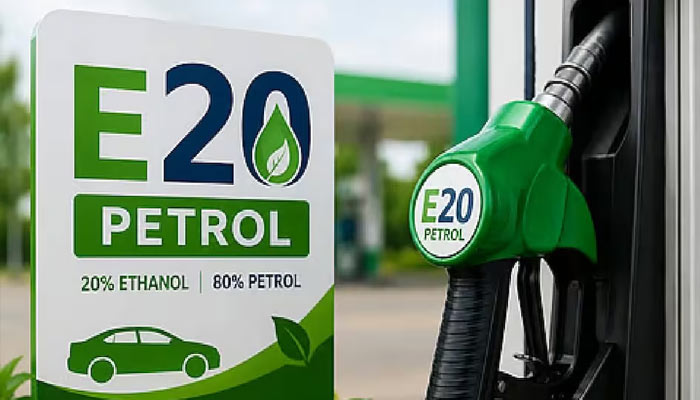
State-owned oil marketing companies Indian Oil Corporation (IOC)
Bharat Petroleum Corporation Limited (BPCL) and Hindustan Petroleum Corporation Limited (HPCL) have rejected recent claims of contamination in E20 petrol, saying an extensive nationwide testing exercise found no evidence of widespread chloride or moisture contamination.
The companies said scientifically designed random tests conducted across the E20 fuel supply chain found fuel quality consistently within prescribed specifications, adding that there was “no cause for alarm”.
The clarification comes amid recent concerns over excessive chloride levels and possible water contamination in ethanol-blended petrol, commonly known as E20.
Oil Firms Intensify E20 Quality Checks
IOC, BPCL and HPCL said the government has prescribed strict chloride limits for ethanol used in petrol blending, along with frequent monitoring across the supply chain.
Checks are being conducted at refineries, ethanol distilleries, depots, terminals and retail outlets to ensure fuel quality is maintained from production to the point of sale.
The companies have also increased surveillance at retail outlets, conducting water-ingress and density checks eight to 12 times a day.
Mobile fuel-testing laboratories have been deployed at various locations, while samples are also being independently verified by accredited fuel laboratories.
Refinery Tests Show Chloride Below 1 PPM
More than 100 randomly selected petrol samples collected from refineries across the country recorded chloride levels of 1 ppm or below, according to the oil companies.
They said the results demonstrate that petrol leaving refineries is meeting the prescribed quality standards and that existing quality-control systems remain effective.
Ethanol Samples From 80 Distilleries Tested
A dedicated task force comprising officials from the three oil companies and the Centre for High Technology (CHT) tested ethanol samples from 80 distilleries over the past 10 days.
All samples recorded chloride levels below 3 ppm, which the companies said was well within the prescribed limit.
The findings, according to the companies, indicate that quality controls at the ethanol production stage are functioning effectively.
- Depot And Terminal Tests Also Within Limits
- Testing was also carried out at depots and tank-truck terminals.
More than 80 samples collected from oil company terminals recorded chloride levels below 3 ppm and met the prescribed specifications, the companies said.
Regular checks at storage and distribution facilities are being used to monitor fuel quality before supplies reach retail outlets.
Retail Tests Find No Widespread Contamination
The companies said more than 1,000 samples have been collected from retail outlets as part of an intensified monitoring programme.
Of the 160 reports analysed in recent days, chloride levels were found to range between 0 and 3 ppm, contradicting claims that E20 petrol contained chloride concentrations running into several hundred ppm.
The companies said four isolated cases of elevated chloride levels were detected during the surveillance exercise. Supplies from those locations were immediately suspended, followed by root-cause investigations and corrective action before operations resumed.
No Evidence Of Water Contamination
IOC, BPCL and HPCL also addressed concerns about moisture entering underground fuel storage tanks.
Around 90,000 retail outlets have begun mandatory inspections and monitoring of underground storage tanks, with checks being conducted eight to 12 times a day.
The companies said the inspections carried out so far have found no evidence of water ingress.
The three oil marketing companies maintained that the nationwide testing and intensified monitoring demonstrate that E20 petrol continues to meet prescribed quality standards and that there is no evidence of widespread contamination.
Comments are closed.