
Title: Wildfires Sweep Europe, Hundreds Evacuated From Resorts In Croatia And Greece

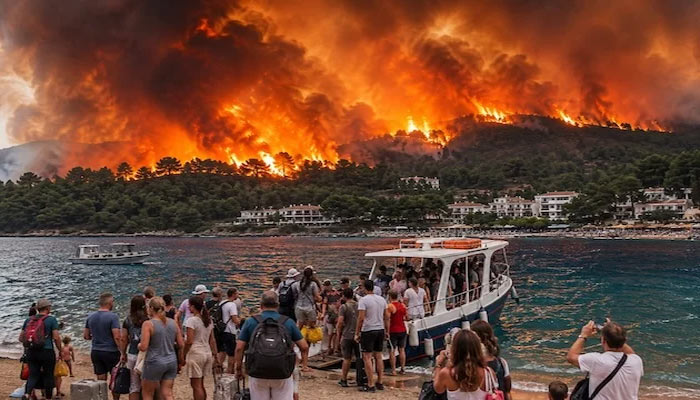
Wildfires continued to rage across parts of Europe on Friday, forcing mass evacuations in Croatia, Greece and France as authorities warned of “very extreme” fire conditions in several regions.
In Croatia, a wildfire swept through homes and vegetation around the coastal resort town of Omis, prompting the evacuation of around 1,200 people. The blaze, which spread across more than 1,000 hectares, injured 40 people, with seven reported to be in serious condition.
Firefighters managed to bring the Croatian blaze under control by Friday morning, with no active flames reported. Officials said the fire caused extensive damage to homes and other property.
Hundreds Evacuated From Greek Resort
In northern Greece, more than 300 people were evacuated by sea from the seaside resort of Siviri after flames spread through nearby forested areas. Residents wearing masks and carrying children and pets were taken to safety aboard dinghies, boats and fishing vessels.
More than 140 firefighters, supported by nine aircraft and seven helicopters, were deployed to contain the blaze.
France Evacuates Hundreds
In southwestern France, authorities evacuated 525 people from the village of Luglon after a wildfire broke out in the Landes region. The area is located near locations that have already suffered major fires this summer.
Meanwhile, in Spain, the remains of three 11th-century kings of Aragón were removed from a monastery threatened by a wildfire.
‘Very Extreme’ Fire Conditions Across Europe
The European Union’s Copernicus Climate Change Service has warned of “very extreme” wildfire conditions across large parts of central and eastern Europe, with additional high-risk areas in southern Britain, Ireland, northern France and southern Sweden.
Extreme heat and prolonged drought have contributed to worsening fire conditions across the continent. Scientists have linked the increasing frequency and intensity of such heat events to climate change.
According to Reuters Climate Monitor data, the average high temperature across Western Europe on Friday was forecast at 31.2°C, around 8°C above the 1961-1990 average. Europe as a whole was expected to remain 1.6°C above the same historical average.
The prolonged heat and drought are also affecting agriculture, with France’s grain maize production expected to fall to its lowest level since the 1970s as crops suffer from severe summer conditions.
Comments are closed.