
India, Uzbekistan Deepen Strategic Partnership, Agree on Long-Term Uranium Supply

India, Uzbekistan Upgrade Ties, Set Sights On $5 Billion Trade And Uranium Supply
India and Uzbekistan have taken their bilateral relationship to a new level, announcing a Comprehensive Strategic Partnership and agreeing to pursue a long-term uranium supply arrangement.
The announcement came after Prime Minister Narendra Modi held talks with Uzbek President Shavkat Mirziyoyev on Sunday. The upgrade comes as the two nations mark 15 years of their existing strategic partnership.
Speaking at a joint press briefing, Modi said the new framework would be backed by specific and measurable objectives.
“We will move forward by setting concrete goals within this new framework,” the Prime Minister said.
NEW MECHANISM TO DRIVE COOPERATION
To strengthen coordination, India and Uzbekistan will create a Coordination Council headed by their foreign ministers. The countries will also elevate their existing joint commission from the secretary level to the ministerial level.
Modi described Uzbekistan as a key country in Central Asia and an important partner in India’s broader regional engagement.
The two sides intend to expand cooperation across defence, trade, energy, connectivity, technology and other strategic sectors.
DEFENCE COOPERATION TO EXPAND
Defence and security emerged as a key component of the upgraded partnership.
Modi said the two countries would pursue greater direct interaction between their defence industries, including joint production and co-development of defence equipment.
India and Uzbekistan also share concerns over terrorism, extremism and separatism. Modi said both nations remain committed to a policy of zero tolerance towards such threats.
BILATERAL TRADE TARGET OF $5 BILLION
Economic cooperation is another major focus of the new partnership.
Bilateral trade has already crossed the $1 billion mark, and the two governments have set an ambitious target of $5 billion by 2030.
To achieve it, the countries plan to work on improving market access, transport connectivity, banking channels and payment mechanisms.
A joint business summit is also expected to provide a platform for companies from both countries to explore new opportunities. Modi said the two sides would look at infrastructure projects capable of generating mutual economic benefits.
The partnership is also expanding into emerging areas such as artificial intelligence, digital public infrastructure, critical minerals, space and nuclear energy.
URANIUM SUPPLY IN FOCUS
Energy cooperation is set to receive particular attention.
India and Uzbekistan are working towards a long-term uranium supply arrangement, potentially strengthening India’s access to fuel for its civilian nuclear power programme.
The issue was discussed during Modi’s two-day visit, alongside wider cooperation on clean energy and other strategic sectors.
PUSH TO TAKE TIES BEYOND DELHI AND TASHKENT
Modi also called for stronger people-to-people and sub-national ties.
Rather than keeping engagement centred on the two national capitals, India and Uzbekistan will encourage partnerships between their cities and states.
The Prime Minister highlighted common development priorities, including youth empowerment, innovation, inclusive growth and the use of modern technology.
He said the visions of “New Uzbekistan” and “Viksit Bharat 2047” share several common aspirations.
“There is a deep similarity between the aspirations and thinking of India and Uzbekistan,” Modi said.
MODI HONOURED WITH UZBEKISTAN’S TOP STATE AWARD
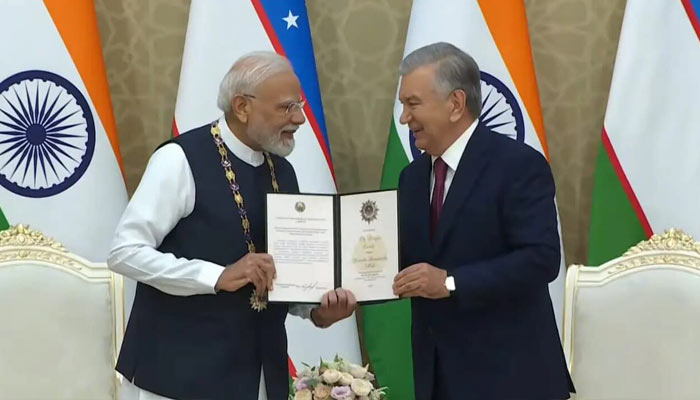
The visit also saw Mirziyoyev confer Uzbekistan’s highest state decoration, the Order of “Oliy Darajali Dustlik”, on Modi.
The honour is the 36th international award received by the Indian Prime Minister.
Modi described the recognition as a matter of pride and dedicated it to the enduring friendship between India and Uzbekistan as well as the people of India.
Reflecting on the award’s name, Modi pointed to the meaning of “Dostlik” — friendship — and noted the familiarity of the word “dost” among Indians.
He said the award symbolised the close relationship between the two countries and belonged not just to him, but to the people of India.
Comments are closed.