

Israeli Strikes Kill 27 in Southern Lebanon, Leave 69 Wounded Amid Escalating Ceasefire Violations
A three-day Israeli military escalation in southern Lebanon has killed at least 27 people and wounded 69 others, with women, children and paramedics among the casualties, as intense airstrikes around Nabatieh created what residents described as a “ring of fire.”
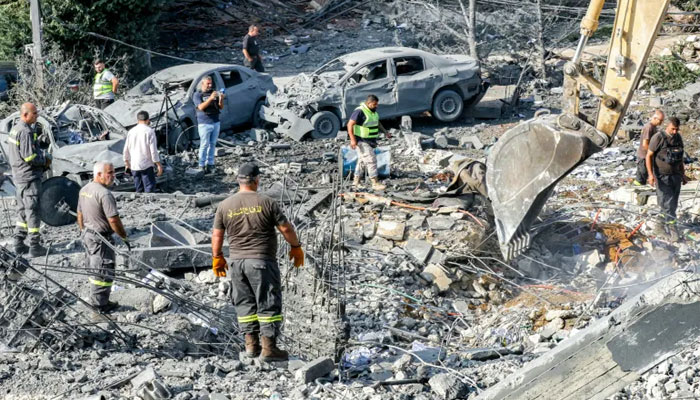
According to Lebanon’s Ministry of Health, 12 people were killed and 10 wounded when an Israeli airstrike hit a residential house in Kafr Rumman, a densely populated town near the Ali Al-Taher heights and north of the Litani River. The victims included two children and four women. Among those injured were three children and a paramedic, who was later killed in another Israeli strike targeting a vehicle in the town.
Israeli strikes over the weekend hit Arab Salim, Kafr Rumman, Nabatieh and surrounding areas, Mayfadoun, Al-Kfour and Al-Ramadiyah, killing 11 people and injuring 26. Earlier attacks from Friday night into Saturday killed four people and wounded 32 others, including women and children.
Lebanon’s Labor Minister Mohamad Haidar said a ministry employee, Hiba Ali Sabah, was killed alongside her husband and daughter when a residential building in Kafr Rumman was struck early Monday. He said several members of her husband’s family were also killed, describing the incident as another attack on Lebanese civilians and residential neighborhoods.
Heavy explosions were also reported in other parts of southern Lebanon on Monday. Israeli strikes hit the coastal town of Al-Mansouri near Tyre and the border town of Hula, destroying homes. In Deir Al-Zahrani, an Israeli evacuation warning was issued for a building overnight Sunday before the structure was destroyed roughly 22 minutes later.
The latest attacks have triggered renewed displacement from villages in Nabatieh district and surrounding areas, further straining a fragile ceasefire.
Israeli army spokeswoman Ella Waweya said the military action came in response to what Israel described as a “flagrant violation” of the ceasefire by Hezbollah, following the launch of an explosive-laden drone toward Israeli forces. She said the military was therefore compelled to take action against the group.
Less than a day earlier, Israeli forces had struck the Finance Ministry building in Nabatieh and Ghandour Hospital. Haidar condemned the attacks as violations of international law and called on the international community and relevant organizations to take immediate action.
The latest escalation has also fueled growing criticism of Hezbollah inside southern Lebanon. Activists from Nabatieh and surrounding areas warned that the district faced the possibility of widespread destruction and displacement, saying residents were being trapped between fear, uncertainty and repeated displacement.
In a statement, the activists blamed Israel for the attacks but also said Hezbollah and Lebanese authorities must answer for decisions that have left southern communities vulnerable. They called for decisions on war and peace to be placed exclusively in the hands of Lebanon’s legitimate state institutions.
The dispute has intensified following Israel’s reported takeover of the Ali Al-Taher heights, a strategically important area overlooking Nabatieh. Hezbollah had reportedly transformed the hills into a fortified position containing military installations and a command center.
Before Israel took control of the area, Hezbollah rejected a proposal by Lebanese authorities to transfer responsibility for the hills to the Lebanese army, saying it would not surrender its weapons north of the Litani River.
The activists argued that the loss of Ali Al-Taher demonstrated the consequences of keeping security decisions outside state institutions. They urged the Lebanese government and army to protect Nabatieh and surrounding villages without waiting for political negotiations or agreements with other parties.
Lebanese Prime Minister Nawaf Salam spoke with Nabatieh Mayor Abbas Fakhr El-Din and reaffirmed the government’s commitment to supporting residents returning to their homes, maintaining public services and meeting the needs of affected communities.
Parliament Speaker Nabih Berri accused Israel of committing “acts of state terrorism” and said it had failed to honor ceasefire arrangements. He also accused Israel of turning southern Lebanon into a zone of destruction and displacement.
Meanwhile, Israel’s public broadcaster reported that the military was awaiting political approval to destroy tunnels in the Ali Al-Taher area. Following the operation, Israeli forces are expected to withdraw from the Yellow Line and reposition along the Gray Line, a strip reportedly extending between 2 km and 4 km from the Israeli border.
Comments are closed.