
Trump’s UNGA Claims Fact-Checked: India-Pakistan ‘Peace’, Climate Change and AI Warnings

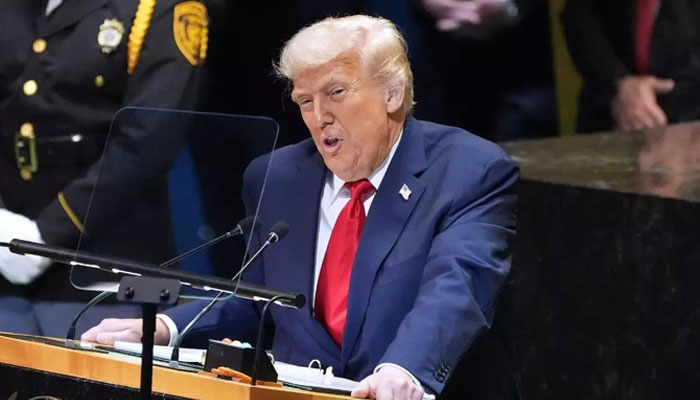
US President Donald Trump used his address to the United Nations General Assembly to highlight.
What he described as major achievements of his administration, ranging from foreign-policy interventions and military strength to energy resources, drug enforcement and artificial intelligence.
Trump claimed credit for helping end several conflicts, said the US and Venezuela together account for more than 60% of the world’s oil, defended America’s military stockpiles and declared that the US is far ahead of China in AI.
Several of those claims, however, require important context. Fact-checkers and available data indicate that some were exaggerated, while others leave out key details or do not match established figures.
Here is a closer look at some of Trump’s major claims and what the available evidence shows.
CLAIM: Trump Helped End the India-Pakistan Conflict
Trump again claimed that he played a role in ending the 2025 India-Pakistan conflict and said Pakistani Prime Minister Shehbaz Sharif had thanked him for his efforts.
THE FACTS: India has repeatedly rejected the description of the May 2025 cessation of military operations as a result of US mediation.
New Delhi’s stated position has been that the decision to halt military action was reached directly between India and Pakistan through established military channels, following Pakistan’s request. Prime Minister Narendra Modi has also said that no third country mediated the cessation.
Pakistan, however, has credited US diplomatic efforts, while Trump publicly announced on May 10, 2025, that the two countries had agreed to an immediate ceasefire. The competing accounts mean that Trump’s role remains disputed: Washington and Islamabad have described a US contribution, while New Delhi has explicitly rejected third-party mediation.
CLAIM: Trump Settled Eight Wars
Trump said it had been his “great honour” to settle eight wars and cited conflicts involving Cambodia and Thailand, Kosovo and Serbia, Rwanda and the Democratic Republic of Congo, India and Pakistan, Armenia and Azerbaijan and Gaza. He has also previously included Israel-Iran and Egypt-Ethiopia in the list.
THE FACTS: The eight-conflict figure does not mean that all eight were wars that Trump ended.
Fact-checkers have noted that some of the situations Trump cites do not fit that description. The Egypt-Ethiopia dispute over the Grand Ethiopian Renaissance Dam was a prolonged diplomatic and water-security dispute, rather than an active war during Trump’s current term. Similarly, the Kosovo-Serbia issue remains an unresolved political dispute over Kosovo’s status.
Trump did broker a 2020 agreement between Kosovo and Serbia aimed at normalising economic relations during his first presidency, but that agreement did not resolve the broader dispute.
CLAIM: The US Has More Munitions Than It Could Ever Need
Trump dismissed suggestions that American weapons stocks were running low and said the United States had more munitions than it could “ever possibly even think of using”.
THE FACTS: The US has substantial military stockpiles and has been expanding weapons production. But officials and analysts have also raised concerns about shortages involving some advanced systems.
The Associated Press reported concerns over US weapons inventories, while fact-checking of Trump’s remarks has pointed to the time required to replenish heavily used missile systems. The evidence therefore does not support treating US ammunition supplies as effectively unlimited.
CLAIM: The US and Venezuela Control More Than 60% of the World’s Oil
Trump said that combining US and Venezuelan oil gives the two countries more than 60% of the world’s oil.
THE FACTS: Available estimates are far lower.
PolitiFact calculated that the United States and Venezuela together account for about 21.9% of the world’s proven oil reserves. Proven reserves refer to quantities considered economically and technically recoverable, making the distinction important when comparing them with broader estimates of oil resources.
CLAIM: US Strikes Destroyed 97% of Drugs Entering by Sea
Trump said US strikes against cartel boats had destroyed 97% of drugs coming into the country by sea.
THE FACTS: Drug seizures cannot establish that percentage.
Authorities can measure the drugs they intercept, but they cannot know precisely how much traffickers successfully move without detection. Fact-checkers have also found that available seizure data does not establish the causal link implied by Trump’s claim.
PolitiFact concluded that the 97% figure was false, noting that seizure numbers measure intercepted drugs rather than the total amount traffickers attempt to transport.
CLAIM: The US Is Far Ahead of China in AI
Trump said the US is leading China in AI “by a lot”.
THE FACTS: The United States does have an advantage in some measures of AI model capability, but the size of that lead is difficult to quantify.
PolitiFact noted that several leading AI figures and experts have described China as only months behind the US in some areas. At the same time, AI development is moving rapidly in both countries, making any fixed assessment of the gap subject to change.
CLAIM: Climate Change and AI Warnings Come From the Same ‘Hoax’ Group
Trump linked warnings about AI risks to people who, in his description, had previously promoted concerns about climate change, the “Russia hoax” and the “Ukraine hoax”.
THE FACTS: Concerns about AI risks extend well beyond one political group.
Leading figures in the technology industry, including Anthropic CEO Dario Amodei, OpenAI CEO Sam Altman, Google DeepMind’s Demis Hassabis and xAI founder Elon Musk, have all expressed concerns about aspects of AI development or its potential risks, although they differ on the nature of those risks and how governments should respond.
CLAIM: AI Has Already Entered the Era of ‘Superintelligence’
Trump said the world should move away from the term “artificial intelligence” and instead use “superintelligence”, describing it as a new technological era.
THE FACTS: “Superintelligence” is an established technical concept, but it does not simply mean today’s AI systems.
In AI research, superintelligence generally refers to systems that would surpass human capabilities across virtually all cognitive tasks. Current AI models can outperform humans in specific areas such as coding, mathematics and other complex tasks, but they remain uneven in their abilities and limitations.
Trump’s proposal to use “superintelligence” as a broader replacement for “artificial intelligence” is therefore a political and rhetorical framing rather than an established technical reclassification of today’s AI systems.
Overall, Trump’s UNGA speech contained a mix of verifiable achievements, disputed interpretations and claims that fact-checkers found misleading or unsupported by available data. The differences are particularly pronounced on the role of the US in the India-Pakistan conflict, the number of wars Trump says he settled, oil reserves, drug seizures and the scale of America’s lead in AI.
Comments are closed.