

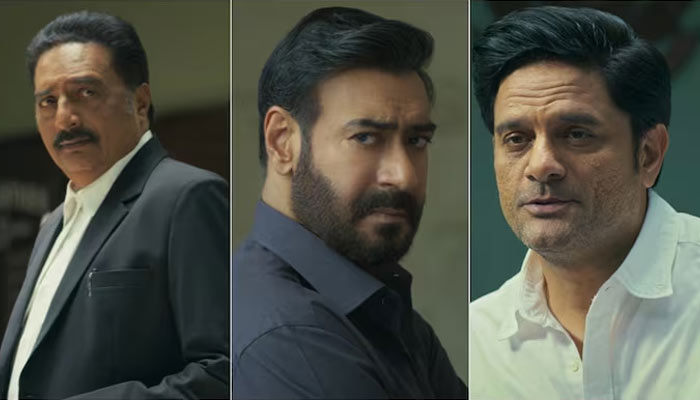
Jaideep Ahlawat Gives Ajay Devgn’s Vijay Salgaonkar His Toughest Challenge Yet in Drishyam: The Conclusion
For two films, Vijay Salgaonkar has lived by one simple principle: stay ahead of everyone else.
He has outsmarted investigators, manipulated timelines, anticipated questions and built an alternate version of reality so convincing that even the truth seemed powerless against it. In Drishyam and Drishyam 2, Ajay Devgn’s Vijay was rarely the strongest man in the room. He was simply the smartest.
Drishyam: The Conclusion finally gives him something he has never truly had — an opponent who refuses to underestimate him.
Enter Jaideep Ahlawat as Rajveer Singh Tomar, a Crime Branch SP whose arrival fundamentally changes the dynamic of the franchise. For the first time, Vijay is not dealing with an investigator who is merely following clues. He is facing someone who understands the way Vijay thinks and is prepared to challenge him on his own turf.
That makes Ahlawat one of the most important additions to the franchise.
Rajveer is introduced with an immediate sense of authority. Unlike the officers who previously pursued Vijay, he does not dismiss him as an ordinary cable operator who somehow got lucky. He recognises that there is a mind behind the carefully constructed story and approaches the case accordingly.
That alone makes him dangerous.
The biggest strength of Ahlawat’s performance is that he does not turn Rajveer into a conventional, loud police antagonist. His menace comes from restraint. His pauses, expressions, body language and quiet confidence suggest a man who is constantly observing and processing information.
Even when he says nothing, it feels as though he is putting another piece of the puzzle into place.
That quality works particularly well opposite Devgn.
Devgn has spent two films making Vijay’s calmness his greatest weapon. Vijay rarely panics. He rarely loses control. He knows when to speak, when to remain silent and when to make others believe exactly what he wants them to believe.
- Ahlawat meets that controlled performance with another form of control.
- Vijay knows how to conceal information.
- Rajveer knows how to search for what has been concealed.
- That becomes the central attraction of their confrontation.
The character is particularly effective because Rajveer does not simply look at objects and events for what they are. He looks at what they can establish. His line about seeing a cigarette not merely as a cigarette but as potential evidence for DNA traces captures his approach perfectly.
For Vijay, every detail can be used to construct a story.
For Rajveer, every detail can be used to dismantle one.
That distinction gives Drishyam: The Conclusion a much-needed sense of uncertainty.
The franchise has always worked because audiences know Vijay is capable of finding a way out. We have watched him do it before. We know how carefully he plans. We know how far ahead he thinks.
But Rajveer introduces the possibility that Vijay may finally be facing someone who has anticipated his methods.
And Ahlawat’s physical presence adds another dimension to that equation.
Ajay Devgn has rarely been made to look physically vulnerable by an adversary in this franchise. Ahlawat’s imposing stature immediately alters the visual balance. When the two share the frame, Vijay no longer automatically feels like the dominant presence.
Yet Rajveer’s threat does not depend entirely on physicality.
His real weapon is his refusal to accept the obvious explanation.
The character also benefits from being fundamentally different from Akshaye Khanna’s investigator in Drishyam 2. Ahlawat does not attempt to replicate what came before. His Rajveer is more assertive, more physically imposing and seemingly more comfortable with the idea of turning the investigation into an intellectual contest.
That makes his arrival feel less like a replacement and more like an escalation.
The franchise’s most interesting moral complication remains intact as well. Audiences have spent years rooting for Vijay despite knowing that he is on the wrong side of the law. His actions began with an extraordinary family crisis, but the years that followed transformed the original crime into something much larger — a battle involving evidence, police investigations, institutional credibility and Vijay’s determination to protect his family at any cost.
Rajveer enters that history without the same emotional baggage.
At least initially, he is not driven by revenge. He is doing his job.
He wants to solve a case that has embarrassed the Goa Police for years and refuses to accept that the answers are already buried.
That makes him more compelling than a standard villain.
The pre-interval portions benefit enormously from this approach. Rajveer is positioned as an adversary without being reduced to a corrupt or abusive police officer. His obsession is not power. It is the truth.
Unfortunately, the film does not sustain that conflict as strongly as it could have.
The biggest weakness of Rajveer’s character is ultimately the screenplay. After establishing him as the most formidable opponent Vijay has ever faced, the second half takes him away from the very investigation that makes him interesting.
Instead of constantly tightening the net around Vijay, Rajveer becomes occupied with other responsibilities and meetings. Those duties may be logical for a senior police officer, but dramatically they weaken the central confrontation the film has spent so much time building.
That is a missed opportunity.
Because Ahlawat had already demonstrated what the final Drishyam battle could have looked like.
Vijay had finally met someone who could match his patience. Someone who could question every detail. Someone who could look at the carefully constructed Salgaonkar narrative and refuse to accept it.
The film comes tantalisingly close to turning that into a definitive battle between two exceptionally calculating minds.
It just does not push the conflict far enough.
Still, Ahlawat leaves a significant mark on the franchise.
For years, the greatest question surrounding Vijay Salgaonkar was not whether he could outsmart the police. It was how long he could continue doing it.
Rajveer changes that question.
For the first time, audiences are made to seriously consider another possibility: what if Vijay has finally met someone who can beat him?
Jaideep Ahlawat does not necessarily need to defeat Vijay Salgaonkar to achieve that.
He only needs to make us believe that Vijay can lose.
And that, in itself, is perhaps the biggest victory of Rajveer Singh Tomar.
Comments are closed.