

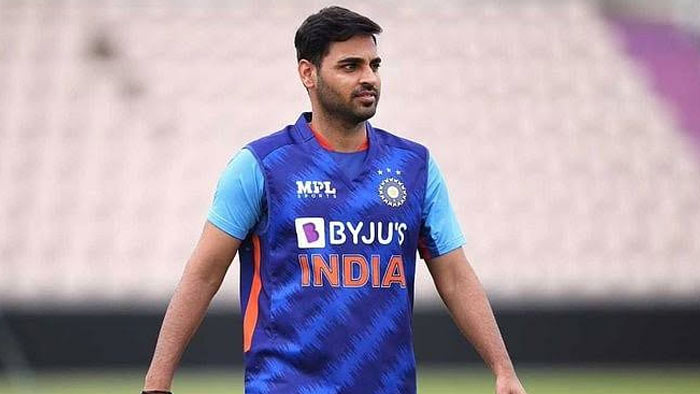
Bhuvneshwar Kumar is back in India’s T20I set-up, nearly four years after his last appearance in the format.
At 36, the veteran seamer has been picked for the five-match series against New Zealand in October, joining Arshdeep Singh, Mayank Yadav and Prince Yadav in the pace group, with Jasprit Bumrah rested.
On the surface, the selection is easy to understand. Bhuvneshwar has done what any player outside the national set-up needs to do — perform consistently. His recent IPL campaigns with Royal Challengers Bengaluru have underlined the qualities that made him one of India’s most reliable white-ball bowlers: movement with the new ball, accuracy, variations and the ability to handle pressure.
Yet his return also raises a bigger question. After several years of trying to build the next generation of Indian T20 fast bowlers, why does India still find itself turning to a 36-year-old when Bumrah is unavailable?
The numbers underline the problem.
Since 2022, India have given T20I opportunities to a long list of fast bowlers. But only a handful have managed to establish themselves as regular members of the side. Arshdeep Singh has emerged as the clear frontline option, while Bumrah has remained the other constant whenever available.
The rest have largely come and gone.
Arshdeep has played 75 T20Is in this period and taken 112 wickets. Bumrah has 56 wickets from 40 matches. Among the other specialist quicks, the numbers are far more modest: Mukesh Kumar has played 17 matches, Harshit Rana 14, Avesh Khan 10, Mohammed Siraj 10, Prasidh Krishna eight, Mayank Yadav seven and Prince Yadav six.
There have been other auditions too — Shivam Mavi, Umran Malik, Khaleel Ahmed, Yash Thakur, Tushar Deshpande, Deepak Chahar and Harshal Patel have all been tried at various points.
But none has converted a run of opportunities into a permanent place.
Hardik Pandya and Shivam Dube complicate the picture because both have contributed with the ball while being picked primarily for their all-round value. Pandya has taken 52 wickets in 58 matches during this period, while Dube has 35 in 67.
The issue, therefore, is not a lack of names. It is the absence of a clear succession line.
India’s last two T20 World Cup squads offer perhaps the clearest evidence.
India’s pace groups at the last two T20 World Cups
| 2024 T20 World Cup | 2026 T20 World Cup |
|---|
| Jasprit Bumrah | Jasprit Bumrah |
| Arshdeep Singh | Arshdeep Singh |
| Mohammed Siraj | Mohammed Siraj |
| Hardik Pandya | Hardik Pandya |
| Shivam Dube | Shivam Dube |
| — | Harshit Rana |
The change is striking. Across two World Cups, only Harshit Rana emerged as a new specialist fast-bowling addition. The other major pace options remained essentially unchanged.
That inevitably raises a question: what did all the bilateral experimentation actually produce?
India have tried Mukesh Kumar, Avesh Khan, Mavi, Umran, Prasidh, Mayank and several others. Giving young bowlers exposure is essential, particularly in T20 cricket, where injuries, workload management and changing conditions can quickly alter team combinations.
But the ultimate purpose of those opportunities is to identify players who can be trusted when the stakes are highest.
So far, that transition has been limited.
There are legitimate explanations. Fast bowling is particularly vulnerable to injuries and fitness setbacks. Prasidh and Harshit have had interruptions, while Mayank’s international career has also been affected by fitness concerns. Some selections were driven by specific conditions or tactical requirements rather than a long-term succession strategy.
Nor does every bowler who receives an international opportunity automatically deserve an extended run. Selection has to remain performance-driven.
Still, the pattern is difficult to overlook.
India have repeatedly opened the door to young fast bowlers, but very few have managed to keep it open.
That makes Bhuvneshwar’s recall particularly intriguing.
His selection should not be dismissed as nostalgia or a failure to move forward. If anything, it is evidence that a player who continues to perform can force his way back into contention regardless of age. Bhuvneshwar’s experience, new-ball control and understanding of T20 cricket give India something that many younger options have yet to establish.
For the immediate New Zealand series, that could be valuable.
For India’s longer-term planning, however, his return should serve as a reminder.
The IPL continues to produce Indian fast-bowling options who have impressed domestically without yet establishing themselves internationally. Anshul Kamboj, Mukesh Choudhary and Kartik Tyagi are among those who have attracted attention, but the jump from promising IPL performer to dependable international bowler remains a significant one.
The timing of Bhuvneshwar’s return also adds another layer.
PTI reported that Central Zone selector RP Singh had previously backed his comeback but that the proposal did not receive sufficient support during Ajit Agarkar’s tenure as chairman of selectors. Bhuvneshwar’s recall came in the first selection meeting under interim chairman Pragyan Ojha after Agarkar’s departure.
That does not necessarily mean the change in leadership caused the selection. Bhuvneshwar’s recent performances provide a clear cricketing argument for his inclusion. But the timing inevitably invites discussion about how India’s selection philosophy is evolving.
Agarkar’s tenure was broadly associated with looking ahead and giving younger players opportunities rather than repeatedly reopening doors for established names. Bhuvneshwar, in that sense, represented the other side of the debate.
There is nothing inherently wrong with either approach.
A selection policy that refuses to pick an older player simply because of his age can be just as flawed as one that keeps returning to veterans without evidence of current form.
Bhuvneshwar’s case is different because his recent performances have earned him another opportunity.
But that is precisely why his comeback matters beyond one five-match series.
India do not appear to be short of fast-bowling talent. They have had a steady supply of bowlers capable of earning an international call-up.
What they have struggled to find is the bowler who turns that opportunity into a sustained claim on the T20I shirt.
Bhuvneshwar’s return solves an immediate problem. It does not solve the succession problem.
At 36, he has earned another chance. The bigger challenge for Indian cricket is ensuring that by the time he is no longer available, there is no need to look backwards.
Comments are closed.