
Fight Sujeet Kalkal, Fight: How an Indian Wrestler Turned Adversity Into Asian Games Gold

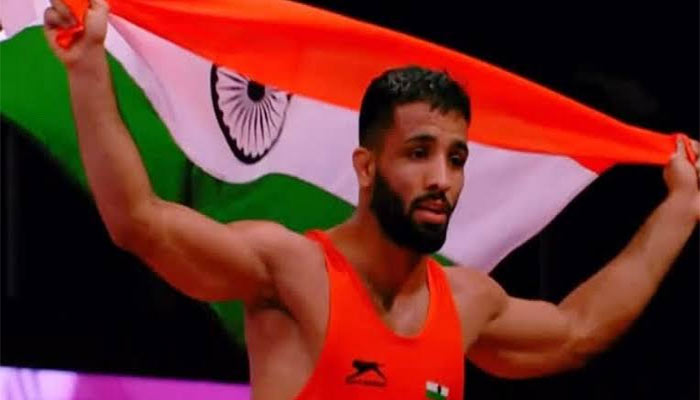
Comebacks are nothing new for Sujeet Kalkal. The 23-year-old Indian wrestler has had to overcome disappointment before, but his latest fightback has given his career a defining moment.
Two years ago, Kalkal saw his Olympic dream disappear in heartbreaking circumstances. He was travelling to Kyrgyzstan for the Asian Olympic qualifying tournament when floods disrupted his journey and left him stranded in Dubai for three days. By the time he eventually reached Kyrgyzstan, his opportunity to qualify for the Paris Olympics had passed.
At the Asian Games in Nagoya, history appeared to be repeating itself.
In the men’s 65kg freestyle wrestling final, Kalkal found himself in a difficult position against Tajikistan’s Abdulmazhid Kudiev. The Indian was trailing 2-9, with time running out and the gold medal seemingly slipping away.
Then came the fightback.
Kalkal produced a stunning eight-point scoring burst to overturn the deficit and move 10-9 ahead. Kudiev struggled to respond as the Indian wrestler defended his narrow lead through the closing moments to complete one of the most remarkable comebacks of the Games.
The victory ended India’s eight-year wait for a men’s wrestling gold at the Asian Games.
It also put Kalkal in an exclusive club. He became only the third Indian to win the men’s 65kg freestyle title at the Asian Games, following Yogeshwar Dutt’s triumph in 2014 and Bajrang Punia’s gold in 2018.
So what changed during those crucial moments? Was it a tactical adjustment, an error from Kudiev or simply Kalkal’s refusal to give up?
For the Indian wrestler, the answer was much simpler: keep fighting.
Kalkal said he deliberately avoided thinking about his Olympic disappointment while competing in the final. Instead, he focused on what he could still control.
“I don’t focus too much on things that have already happened. In Paris, it wasn’t really in our hands. It was almost like a natural disaster, there were floods and we couldn’t reach the venue. There was nothing we could do about that,” he said during a virtual interaction.
“Our job is to keep trying. In a final, even if I am losing, my duty is to fight until my last breath. That’s what I did in that final. I told myself that whatever strength and energy I had left, I had to give everything. I did that and won the gold for the country.”
FROM ASIAN GAMES GOLD TO THE OLYMPIC DREAM
For Kalkal, the Asian Games gold is the biggest achievement of his career so far. But he already has his eyes on an even bigger prize.
The World Wrestling Championships in Kazakhstan are next, followed by the ultimate target — the Olympics.
“The Asian Games gold is my biggest achievement so far. The World Championships are coming up, and winning there would be an even bigger achievement,” Kalkal said.
“But ultimately, the Olympics are the final stage. Nothing can give you more happiness than becoming an Olympic champion because that is every athlete’s dream. That would be the biggest achievement for me.”
For someone who was denied the chance to compete at the Paris Olympics, the dream carries added significance.
‘MY DIWALI IS WINNING A MEDAL’
Kalkal’s next major challenge will come at the World Wrestling Championships in Kazakhstan, scheduled from October 24 to November 1. With the medal bouts expected around Diwali, the wrestler knows he is likely to spend another festival away from home.
But for Kalkal, medals have become celebrations of their own.
“The first thing I want to say is that for a sportsperson, any achievement is itself a celebration. If I achieve something like winning gold for the country at the Asian Games, that is my Diwali,” he said.
“I haven’t really gone home during Diwali or Holi so far because there is always some competition or the other around those festivals.”
His father’s advice has also given him a simple way of looking at the sacrifices that come with life as an elite athlete.
“My father always tells me, ‘If you bring home gold, that automatically becomes Diwali and Holi for us. Don’t worry about anything else.'”
“This time too, there is going to be a competition around Diwali. I know I’ll be competing then. So if I win gold for the country, that will be Diwali for me.”
Two years after an Olympic dream slipped away because of circumstances beyond his control, Kalkal has shown that setbacks do not have to define an athlete’s journey.
His Asian Games triumph was built on the same principle he carried through the final: keep fighting until the very end.
And with the World Championships and the Olympics still ahead, Kalkal’s biggest comeback may yet be to come.
Comments are closed.